Managing Fear in an Emergency
Activity Overview
Difficulty: Intermediate
Time: 45–60 minutes
Location: Suitable indoor or outdoor training area
Best for: Scouts and Explorers
Skills: Emotional control, emergency decision-making, communication, resilience, situational awareness
Fear is a normal response to an emergency. It can make you more alert and help you recognise danger, but if fear turns into panic it can make it harder to think, communicate and make sensible decisions.
Managing fear does not mean trying to stop yourself from being frightened. Instead, the aim is to recognise the feeling, slow your response down and focus on what needs to happen next.
A useful sequence is:
Stop → Breathe → Assess → Prioritise → Act → Reassess
The same approach works whether you are dealing with a minor outdoor incident or a more serious emergency while waiting for help.
What You’ll Learn
You will learn how fear affects your body and thinking, how to recognise when stress is beginning to affect your decisions, and how to regain enough control to respond sensibly.
You will also practise communicating during stressful situations and breaking an apparently overwhelming problem into smaller, manageable actions.
These skills complement practical emergency skills such as navigation, first aid, shelter building and emergency signalling.
🟢 SAFETY – LOW RISK
This is primarily a psychological and communication exercise, so the activity itself has a low physical risk. Training scenarios should remain controlled and should never deliberately frighten or distress Scouts.
Leaders should explain that participants can stop an exercise at any time. Any outdoor scenario should use a safe location, appropriate supervision and normal emergency arrangements.
Equipment
No specialist equipment is required. A notebook can be useful for recording observations and decisions.
For practical exercises, ordinary Scout equipment such as a map, compass, whistle, torch or first-aid kit can be incorporated into scenarios. This makes the exercises more realistic while keeping them controlled.
Prerequisites
Scouts should understand basic outdoor safety and know how to contact a responsible adult or emergency services when necessary.
Basic knowledge of first aid, navigation and emergency procedures is useful, because managing fear is intended to help Scouts use those skills effectively under pressure.
Instructions
1. Understand What Fear Does
Fear triggers physical and mental changes designed to help you respond to danger.
Your heart may beat faster, your breathing may change and your muscles may tense. You may become extremely focused on the perceived danger.
These reactions are not a sign that you are weak or incapable. They are normal responses to a stressful situation.
The important skill is recognising when fear is beginning to interfere with your ability to think and act.
2. Stop and Create a Pause
When something unexpected happens, the first instinct can be to act immediately.
That is not always helpful.
If you are in a safe enough position to do so, pause for a moment before making your next decision. Look around and identify the immediate danger.
A few seconds of deliberate thinking can prevent you from rushing into another hazard.
3. Control Your Breathing
Fear can cause rapid, shallow breathing. Deliberately slowing your breathing can help you regain concentration.
Take steady, comfortable breaths and focus your attention on the immediate task.
Do not turn this into a complicated breathing exercise during an emergency. The objective is simply to avoid letting rapid breathing and panic take over your attention.
4. Name the Problem
Fear often becomes worse when the situation feels vague or uncontrollable.
Turn the problem into a clear statement.
Instead of thinking:
“Everything is going wrong.”
Think:
“We have lost the route and need to establish where we are.”
Or:
“One person is injured and we need to make them safe and get help.”
A specific problem is easier to deal with than a general sense of panic.
5. Separate Danger From Discomfort
Not everything that feels frightening is an immediate danger.
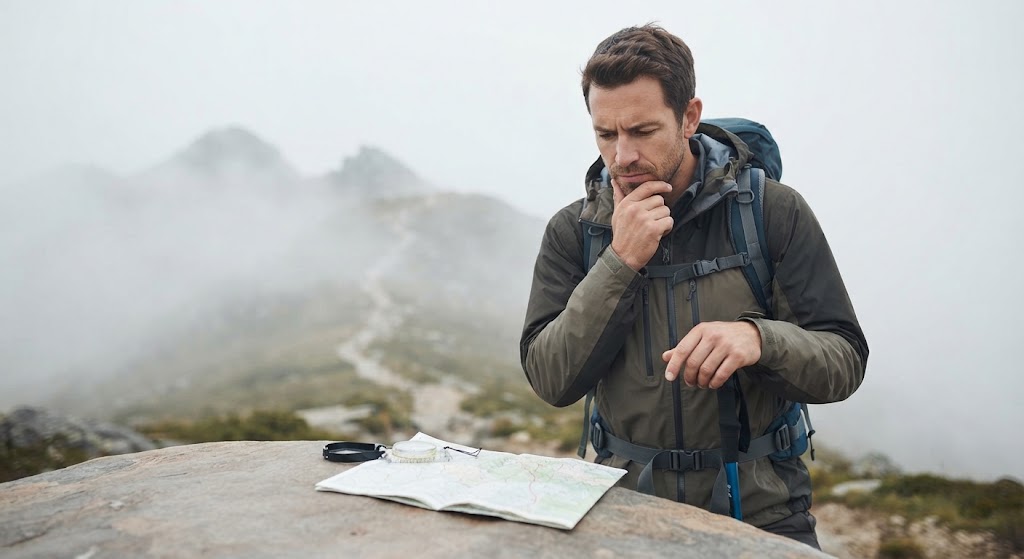
For example, being lost can be extremely worrying, but wandering randomly may make the situation worse. A better response is to stop, establish your last known location and follow your group’s emergency procedure.
Ask:
What could hurt us right now? What needs dealing with first? What can wait?
This helps turn fear into useful action.
6. Focus on the Next Action
Do not try to mentally solve the entire emergency at once.
Choose the most important safe action and concentrate on that.
You might need to move away from an immediate hazard, provide first aid, contact help, protect someone from the weather or establish your location.
Once that task is complete, reassess the situation and decide what comes next.
This prevents your mind from becoming overwhelmed by everything that still needs to be done.
7. Use Clear Communication
Fear can make people talk quickly, shout or stop communicating altogether.
Use short, clear statements.
Tell people what has happened, what you are doing and what you need them to do.
For example:
“Stay here. Keep together. I’m going to get the leader.”
Clear communication reduces confusion and helps the group work together.
8. Avoid Panic Spreading Through the Group
Fear can spread quickly when people see others becoming distressed.
A calm person can have a positive effect on everyone else.
This does not mean pretending that there is no problem. Instead, acknowledge the situation while keeping communication practical.
“Yes, this is worrying. We are going to deal with it one step at a time.”
This gives the group something useful to focus on.
9. Recognise When Someone Needs Help
People react differently to emergencies. Someone might become very quiet, confused, tearful, angry or unable to make decisions.
Do not assume that they are simply being difficult.
Give clear instructions and reassurance. Move them away from unnecessary stress where possible and involve the responsible adult.
If someone is experiencing a serious medical or psychological reaction, treat it as a genuine welfare concern and seek appropriate help.
10. Practise Decision-Making Under Pressure
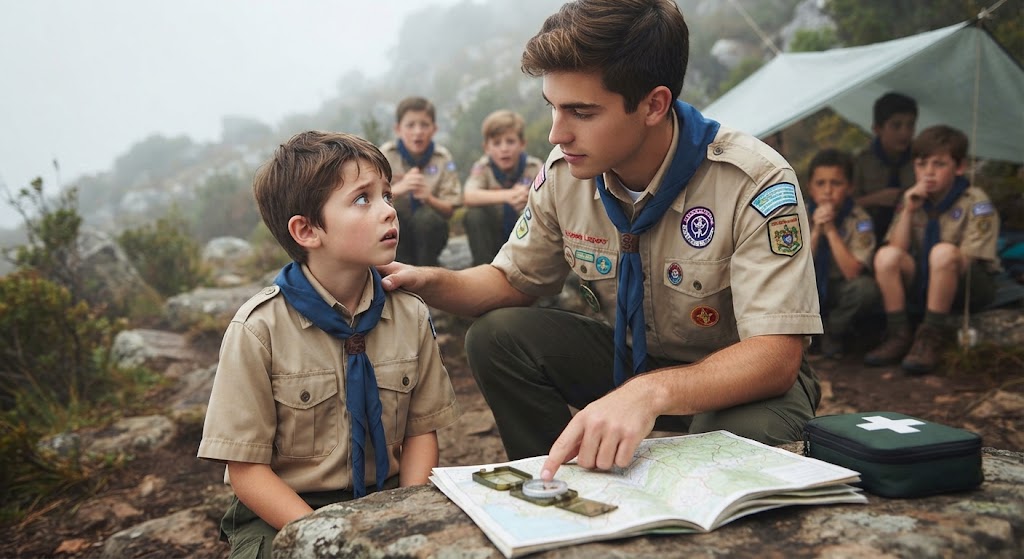
Create short, controlled scenarios during a Scout meeting.
For example:
“You are walking as a group when the weather suddenly becomes much worse and you realise you are no longer certain of your route. What do you do?”
Give the Scouts time to respond.
Afterwards, discuss what they noticed first, whether anyone felt rushed into a decision and how they could make their response calmer and more organised.
The purpose is not to frighten participants. It is to make the pause-and-assess response familiar before a real emergency occurs.
11. Build Confidence Through Preparation
One of the best ways to reduce unnecessary fear is preparation.
Practise the skills you may need: navigation, first aid, emergency communication, shelter, clothing selection and signalling.
Knowing that you have practised these skills gives you something concrete to rely on when circumstances become stressful.
Confidence should come from preparation, not from assuming that nothing will go wrong.
12. Reassess After Every Major Change
An emergency can change quickly.
Weather may deteriorate, someone’s condition may change or a previously safe location may become unsuitable.
Do not become so focused on your original plan that you ignore new information.
Ask:
Has anything changed? Is our plan still safe? What is the priority now?
Being willing to change your plan is an important part of managing fear and making good decisions.
Final Tip
Fear is not the enemy. Panic is simply a signal that you need to slow down and regain control.
You do not need to feel completely calm before taking sensible action. Stop, breathe, identify the immediate problem and deal with the next safe step. With practice, this response can become a habit that helps you stay effective when an emergency feels frightening.
🔒Ready to test your survival skills?
Join Survival Guides UK for free, complete challenges, earn badges and increase your Survival Level.
JOIN FREE →
CRAIG BURR
FOUNDER · SURVIVAL GUIDES UK
I'm Craig, the person behind Survival Guides UK. I created SGUK because I wanted somewhere people could learn real outdoor skills in a practical, straightforward way — from lighting a fire and tying knots to navigation, campcraft and everything in between.
You can read more about the story behind SGUK here as well as our approach here.