How to Retrace Your Route
Knowing how to retrace your route is an important outdoor skill.
You might need to do it if you take the wrong path while hiking, miss a turning while scouting, or become unsure about where you are in the countryside.
Retracing your route means going back the way you came until you reach a place you recognise.
The most important thing to remember is this:
If you think you are lost, stop before you keep walking.
Walking further without knowing where you are can make it much harder to find your way back.
Stop and Stay Calm
The first thing to do when you realise something is wrong is to stop.
Don’t rush off in a random direction.
Take a few deep breaths and think about where you have been.
Ask yourself:
- Where was the last place I knew exactly where I was?
- Which way was I walking?
- What did I see along the way?
- Did I cross a stream or bridge?
- Did I pass a gate, stile or signpost?
- Did I turn onto a different path?
- How long have I been walking since I last knew where I was?
You may find that you are not actually lost. You may simply have missed a turning or walked past a landmark.
Stopping gives you time to work out what happened.
Find Your Last Known Location
Your last known location is the last place where you were sure of where you were.
For example, you might remember being at a crossroads, a footpath sign, a bridge or a particular hill.
This is very useful because you don’t have to work out where you are in the whole countryside.
Instead, you just need to work out how to get back to that known point.
Think:
“How can I safely get back to the last place I knew where I was?”
That is usually a much easier question to answer.
Look for Your Footprints
Sometimes your own tracks can help you find your way back.
This is easiest when you are walking on:
- Mud
- Snow
- Sand
- Soft soil
- Wet ground
You may also spot other signs that you have already been there.
Look for:
- Footprints
- Marks from walking poles
- Flattened grass
- Broken twigs
- Disturbed leaves
- Scuffed soil
- Small stones that have been moved
Be careful, though. Not every footprint or broken branch belongs to you.
Other walkers, animals, wind and rain can leave similar signs.
Use tracks together with other clues rather than trusting them on their own.
Use Landmarks
A landmark is something that is easy to recognise and can help you work out where you are.
Good landmarks include:
- Large rocks
- Unusual trees
- Bridges
- Streams
- Gates
- Stiles
- Signposts
- Buildings
- Roads
- Hilltops
- Woodland edges
- Large bends in a path
Try to remember these things as you walk.
For example, you might remember:
“I walked downhill, passed a large tree, crossed a stream and then went through a gate.”
If you retrace your route and see those things in the same order, you can be more confident that you are going the right way.
Look Behind You
Here’s a simple trick that many people forget.
Turn around and look behind you from time to time.
A path can look very different when you are travelling in the opposite direction.
A hill, tree or building that was easy to see from one direction might look completely different when you return.
If you regularly look behind you during a walk, you will have a better idea of what the route should look like when you are coming back.
Use Your Map
A map is one of the most useful tools you can carry outdoors.
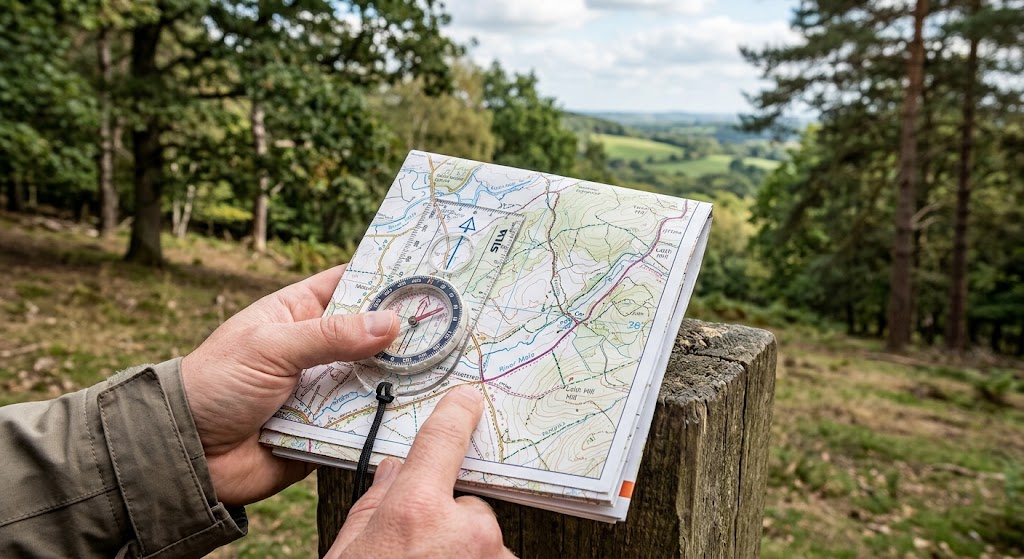
For walking in the UK, an Ordnance Survey map can show many useful features, including paths, roads, rivers, streams, buildings, woods and hills.
It can also show contour lines.
Contour lines are lines on a map that show the shape and height of the land. They can help you understand whether you should be walking uphill, downhill or across a fairly level area.
Look at the map and compare it with what you can see around you.
For example, if you remember walking downhill towards a stream, look for a downhill section and a stream in the same area of the map.
The more features that match, the more confident you can be about your location.
Learn to Read Grid References
Grid references are another useful map skill.
They allow you to describe a particular location on a map.
You may have learned about four-figure or six-figure grid references through scouting or navigation training.
A six-figure grid reference can give a much more exact location than a four-figure grid reference.
Learning how to use grid references is useful when hiking because you can use them to describe where you are to someone else.
They can also help you find a particular point on your map.
Use a Compass
A compass can help you keep track of which direction you are travelling.
If you recorded your original compass bearing, you can also use it to work out the direction back.
To reverse a bearing, you normally add or subtract 180 degrees.
For example:
- 040° becomes 220°
- 070° becomes 250°
- 090° becomes 270°
- 135° becomes 315°
- 180° becomes 000°
- 225° becomes 045°
This is called the reciprocal bearing.
However, don’t expect a compass to lead you exactly along a winding footpath.
A path may turn several times as it goes around hills, trees or other obstacles.
A compass works best when you use it together with your map and the landscape around you.
Use Your GPS
Many hikers now use a phone or GPS device to record their route.
If you have recorded your walk, you may be able to look at the route on your device and see where you have already been.
This can be very helpful if you take a wrong turn.
You may be able to follow your recorded track back to the place where you left your route.
GPS is useful, but don’t depend on it completely.
Your phone battery could run out. Your device could become damaged or you may have trouble using it in heavy rain or cold weather.
A paper map and compass are good backup tools.
Retrace Your Route Slowly
Once you have worked out that you need to go back, don’t rush.
Walk slowly and pay attention to what you see.
Look for the landmarks you remember from the way out.
You might recognise:
- A large rock
- A gate
- A stream
- A bend in the path
- A particular tree
- A signpost
- A view across the valley
Stop whenever you see something familiar and check your map if you have one.
The aim is not simply to walk backwards as quickly as possible.
The aim is to find your way back safely.
Don’t Follow a Dangerous Route
Retracing your route does not mean you should blindly follow your old footprints.
Conditions can change.
A stream that was easy to cross earlier might have become deeper after heavy rain.
A path that was safe in daylight might be difficult in darkness.
Ice, snow, mud and strong winds can also make a route more dangerous.
Watch out for:
- Steep slopes
- Cliffs
- Deep water
- Fast-flowing streams
- Unstable rocks
- Boggy ground
- Slippery paths
- Busy roads
If the route you came along is no longer safe, stop and think about what to do instead.
Getting back to safety is more important than following the exact route you took earlier.
What If You Can’t Find Your Route?
If you cannot find the route you came along, stop again.
Don’t start running around looking for it.
Check your map and compass.
Look around you for landmarks.
Check your GPS if you have one.
Think about the last place where you definitely knew where you were.
You may be able to retrace your route from there.
If you still cannot work out where you are, it may be safer to stay where you are rather than continuing to walk without a plan.
What If You Are Completely Lost?
There is a difference between taking a wrong turn and being completely lost.
If you know you have taken the wrong path, you may be able to simply turn around and retrace your route.
If you have no idea where you are, walking in a random direction is usually a bad idea.
Stop and think.
Use everything you have available:
- Map
- Compass
- GPS
- Landmarks
- Grid references
- Route notes
- Mobile phone
- Emergency equipment
If you are in serious trouble, contact the appropriate emergency service and give them as much useful information as possible.
If you have called for help, stay in a safe place unless you are in immediate danger or are told to move.
How to Make Retracing Your Route Easier
The best time to prepare for getting lost is before you start your walk.
Pay Attention to Your Surroundings
Don’t spend the whole walk looking at your feet.
Look around you.
Notice the hills, trees, paths, streams, buildings and other features.
Try to remember what the landscape looks like.
Check Your Map Regularly
Don’t wait until you are lost before looking at your map.
Check it during your walk so you always have a rough idea of where you are.
Remember Important Places
Pay particular attention when you reach:
- Footpath junctions
- Gates
- Stiles
- Bridges
- Streams
- Road crossings
- Campsites
- Car parks
- Hilltops
These places can help you recognise your route later.
Record Your Route
If you have a GPS device or suitable hiking app, recording your route can give you a useful backup.
Make sure you know how to use the device before relying on it.
Carry a Map and Compass
Even if you normally use your phone for navigation, carrying a map and compass is a good idea when exploring unfamiliar countryside.
More importantly, learn how to use them.
Navigation is a skill, and like any skill, it gets better with practice.
Tell Someone Your Plans
Before going on a longer or more remote walk, tell someone where you are going.
Tell them:
- Where you are starting
- Where you plan to go
- Which route you expect to take
- When you expect to return
This means someone knows your plans if you have a problem.
A Simple Way to Remember What to Do
If you think you have gone the wrong way, remember these six steps.
Stop
Don’t keep walking without knowing where you are going.
Think
Remember the last place where you knew exactly where you were.
Look
Search for your footprints, landmarks and other clues.
Check
Use your map, compass or GPS to help confirm your location.
Retrace
If it is safe, carefully follow your route back towards your last known location.
Reassess
Once you reach somewhere familiar, work out where you went wrong before continuing.
Final Thoughts
Knowing how to retrace your route is a useful skill for anyone who enjoys hiking, scouting, camping, bushcraft or exploring the countryside.
You don’t need to panic if you take a wrong turn.
Stop, think about where you last knew your location and look for clues that can lead you back.
Use landmarks, footprints, maps, compass bearings and GPS to help you.
Most importantly, don’t wait until you are lost to practise navigation.
Learn how to read a map, use a compass and pay attention to the landscape around you.
Good navigation is not just about finding your way back.
It is about knowing where you are in the first place.
🔒Ready to test your survival skills?
Join Survival Guides UK for free, complete challenges, earn badges and increase your Survival Level.
JOIN FREE →
CRAIG BURR
FOUNDER · SURVIVAL GUIDES UK
I'm Craig, the person behind Survival Guides UK. I created SGUK because I wanted somewhere people could learn real outdoor skills in a practical, straightforward way — from lighting a fire and tying knots to navigation, campcraft and everything in between.
You can read more about the story behind SGUK here as well as our approach here.