10 Easy Survival Skills for Squirrels
Survival skills do not have to be complicated to be useful. For Squirrels, simple outdoor activities can introduce important skills while keeping learning fun and age appropriate.
At this age, the aim should not be to teach children how to deal with extreme survival situations. Instead, Squirrels can learn simple skills that help them become more confident outdoors, understand basic safety and start thinking about how to solve problems.
The best survival activities for Squirrels are hands-on, achievable and fun. A simple shelter-building challenge or learning how to use a whistle can teach valuable lessons without making the activity frightening.
Here are 10 easy survival skills that are suitable for introducing younger children to the basics of outdoor survival.
What You’ll Learn
In this guide, we’ll look at 10 simple survival skills that Squirrels can learn with appropriate adult supervision:
- Outdoor safety
- Using a survival whistle
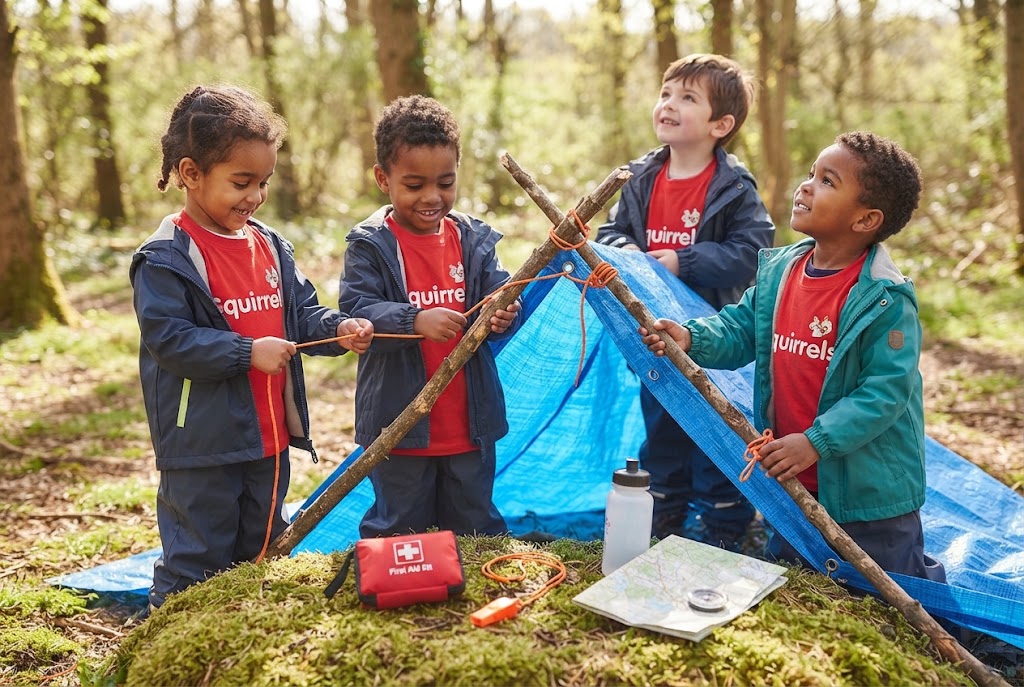
- Building a simple shelter
- Basic knots
- Finding suitable shelter
- Basic navigation
- Looking after drinking water
- Basic first aid awareness
- Recognising weather changes
- Staying calm and asking for help
Equipment
The equipment will depend on which activities you choose, but a Squirrel survival session could use:
- Survival whistles
- Rope or paracord
- Tarpaulins or lightweight shelter material
- Tent pegs
- Maps
- Simple compasses
- First aid kit
- Water bottles
- Waterproof clothing
- Cones or markers for games
You do not need expensive survival equipment. Everyday outdoor equipment can be used to teach many of these skills.
Prerequisites
Squirrels do not need previous survival experience.
The activities should be adapted to the age and ability of the children, with leaders providing appropriate supervision throughout.
Some activities, such as using knives, lighting fires, climbing or working around water, are not included in this list because younger children require particularly careful supervision and risk management for these activities.
Instructions
1. Learn Basic Outdoor Safety
The first survival skill every Squirrel should learn is how to stay safe outdoors.
Teach simple rules such as:
- Stay with your group.
- Listen to your leaders.
- Do not wander off without permission.
- Tell an adult if you are lost, hurt or worried.
- Do not touch unknown plants, fungi or animals.
- Stay away from dangerous areas such as roads, steep drops and deep water.
Turn the lesson into a game by giving the Squirrels different scenarios and asking them what they would do.
For example, ask:
“What would you do if you could no longer see your group?”
This encourages them to think about safety rather than simply memorising rules.
2. Learn How to Use a Whistle
A whistle can be a useful way of attracting attention if someone becomes separated from their group.
Teach Squirrels that a whistle is for attracting attention and should not be used simply for fun when other people are nearby.
Practise a simple agreed signal, such as three whistle blasts to indicate that someone needs attention.
Make sure the children understand that they should stay where they are unless a leader or responsible adult has given them different instructions.
3. Build a Simple Shelter
Shelter building is an excellent activity for Squirrels because it involves teamwork and problem-solving.
Give the group a tarpaulin, rope and suitable natural surroundings.
Challenge them to build a small shelter that:
- Provides cover from rain
- Has enough space to sit underneath
- Is stable
- Does not block a path
- Is away from obvious hazards
The children can work together to decide where the shelter should go and how it should be supported.
The activity teaches them that shelter is one of the basic priorities when spending time outdoors.
4. Learn Some Basic Knots
Knots are useful practical skills that children can learn through games.
Start with one or two simple knots rather than trying to teach lots at once.
The Squirrels could use their knots to:
- Tie a shelter
- Secure equipment
- Make a simple washing line
- Join pieces of rope for an activity
Keep the practice short and turn it into a challenge. For example, see which team can correctly tie and check their knot first.
The important part is learning how to make a secure knot rather than simply doing it quickly.
5. Learn How to Choose a Safe Place for Shelter
Building a shelter is only part of the skill. Children can also learn how to decide where a shelter should be located.
Explain that they should avoid places such as:
- The bottom of steep slopes
- Areas beneath unstable branches
- Locations that could flood
- The middle of paths
- Areas close to roads
- Places with obvious hazards
Give the Squirrels several possible locations and ask them to identify which would be the safest place to build a shelter and why.
This turns a simple activity into a basic introduction to risk assessment.
6. Learn Basic Navigation
Squirrels can start learning navigation without needing to understand complicated map reading.
Begin with simple activities involving:
- Left and right
- Following directions
- Recognising landmarks
- Following a marked route
- Finding specific objects or locations
Once they are comfortable with this, introduce a very simple map of the activity area.
A treasure hunt can be a great way to teach these skills while keeping the activity fun.
7. Understand the Importance of Safe Drinking Water
Children should understand that not every source of water outdoors is safe to drink.
Show them different examples of water sources and explain that streams, ponds and other natural water sources can contain harmful organisms or contaminants even when the water looks clean.
For a practical activity, teach them how to carry and look after their own drinking water bottle.
You can also explain that treating water in a real survival situation requires appropriate equipment and knowledge rather than simply drinking from the nearest stream.
8. Learn Basic First Aid Awareness
Squirrels can learn simple first aid awareness without being expected to deal with serious injuries.
Teach them to:
- Tell an adult when someone is hurt
- Know where the first aid kit is kept
- Get help quickly
- Tell an adult what happened
- Avoid touching blood or other bodily fluids
- Follow instructions from a responsible adult
Simple role-playing games can help children practise what they would do if someone had a minor injury.
The emphasis should be on getting help, rather than expecting young children to provide treatment themselves.
9. Learn to Recognise Changes in Weather
Weather can change quickly, particularly when spending time outdoors.
Help Squirrels become more aware of their surroundings by asking them to look for signs such as:
- Darkening clouds
- Increasing wind
- Rain approaching
- Falling temperatures
- Bright sunshine and heat
- Thunder and lightning
Make this into a regular part of outdoor activities.
Before going outside, ask the children what the weather is like and what clothing or equipment might be needed.
This helps them understand that being prepared is an important part of staying safe outdoors.
10. Learn How to Stay Calm and Ask for Help
One of the most important survival skills for a young child is knowing what to do when something goes wrong.
Squirrels should know that if they are frightened, lost, injured or unsure what to do, they should:
- Stop
- Stay calm
- Stay in a safe place
- Call or signal for help
- Tell a trusted adult what has happened
This can be practised through simple games.
For example, pretend that a Squirrel has become separated from their group during an activity. Ask them what they should do and who they should ask for help.
The aim is to give them a simple response they can remember rather than overwhelming them with complicated survival procedures.
Safety Information
Survival activities for Squirrels should always be appropriate for their age and abilities.
Children should be supervised closely during practical activities, particularly when using rope, tent pegs or other equipment.
Avoid introducing unnecessary hazards simply to make an activity seem more like a survival exercise. Squirrels can learn valuable outdoor skills without using knives, axes, fires or other potentially dangerous equipment.
Before running an activity, leaders should consider the environment, weather, equipment and individual needs of the children taking part.
The most important lesson is that survival skills are about staying safe and getting help, not encouraging children to take unnecessary risks.
Final Tip
Keep survival skills for Squirrels simple, practical and fun.
At this age, children are learning the foundations of outdoor confidence. A shelter-building game, a navigation treasure hunt or a whistle activity can teach genuine survival principles while feeling like an adventure.
You do not need to create an extreme survival scenario. The best lessons are often the simple ones that children can remember and use later.
🔒Ready to test your survival skills?
Join Survival Guides UK for free, complete challenges, earn badges and increase your Survival Level.
JOIN FREE →
CRAIG BURR
FOUNDER · SURVIVAL GUIDES UK
I'm Craig, the person behind Survival Guides UK. I created SGUK because I wanted somewhere people could learn real outdoor skills in a practical, straightforward way — from lighting a fire and tying knots to navigation, campcraft and everything in between.
You can read more about the story behind SGUK here as well as our approach here.