Campfire Baking
Activity Overview
Difficulty: Intermediate
Time: 1–2 hours
Location: Suitable campfire or outdoor cooking area
Best for: Scouts and Explorers
Skills: Camp cooking, fire management, food preparation, heat control, teamwork
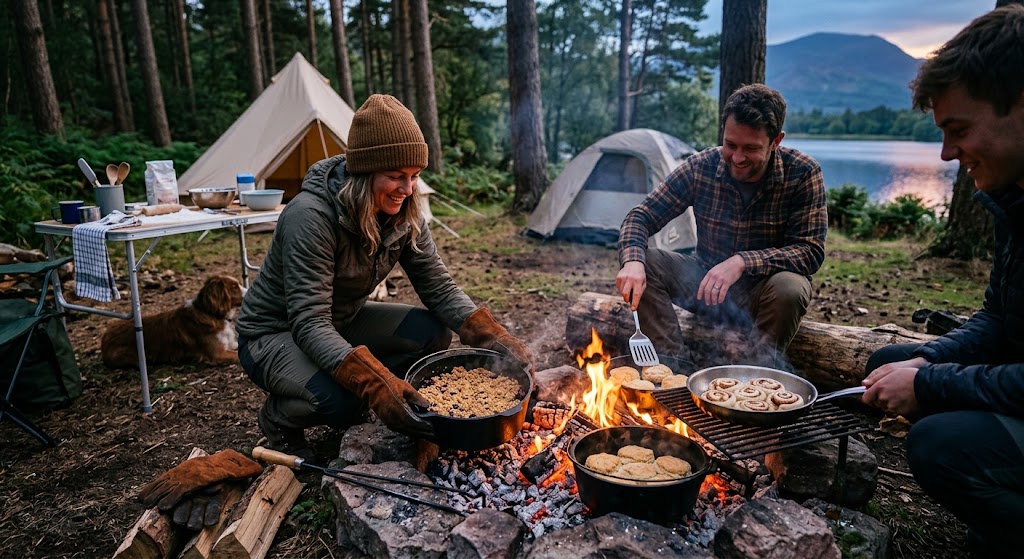
Campfire baking is the process of baking food using the heat from a campfire rather than a conventional oven. It can be used to make bread, bannock, damper, scones, cakes and other simple camp recipes.
The key to successful campfire baking is steady, controlled heat. A large flame is usually less useful than a well-established bed of hot embers, which provides a more consistent temperature.
There are several ways to bake outdoors. A Dutch oven can be heated from underneath and above using embers, while smaller items can be baked in suitable covered cookware or foil. The method you choose will depend on the equipment available and the food being prepared.
What You’ll Learn
You’ll learn how to prepare a suitable fire for baking, create a steady bed of embers and control the heat around your cooking equipment.
You’ll also learn how to prepare food safely, recognise when something is cooking too quickly and make adjustments without disturbing the whole fire.
Campfire baking is particularly useful for developing patience and teamwork. Unlike cooking directly over a flame, baking often requires Scouts to monitor the temperature for a longer period and make small adjustments as they go.
🟡 SAFETY – MODERATE RISK
Campfire baking involves hot fires, cookware and food, so the cooking area should be properly organised and supervised. Keep Scouts aware of the hot zone around the fire and ensure handles, utensils and cookware cannot easily be knocked over.
Use suitable cookware designed for high temperatures. Ordinary glass, unsuitable containers or cookware with plastic components should not be placed directly onto a campfire.
Take care when lifting lids or moving cookware because escaping steam can cause serious burns. Use appropriate heat-resistant gloves or tools and keep your face and hands away when opening covered cookware.
Food hygiene is equally important. Wash hands and equipment, keep raw and cooked ingredients separate and make sure food is thoroughly cooked before eating. Take particular care with foods containing meat, eggs or other ingredients that require thorough cooking.
Never leave the fire unattended. When baking is finished, extinguish the fire safely and make sure the embers are completely out before leaving the cooking area.
Equipment
You’ll need a suitable campfire area, dry firewood and a good supply of embers.
For the baking itself, a Dutch oven with a suitable lid is one of the most useful pieces of equipment. It allows heat to be applied from both underneath and above, creating an environment similar to an oven.
Depending on the recipe, you may also need a mixing bowl, measuring equipment, utensils, heat-resistant gloves, a trivet or grill and suitable containers for preparing and serving the food.
Have all ingredients prepared before starting the baking process. This makes it easier to concentrate on managing the fire and cooking temperature.
Prerequisites
Scouts should already understand basic campfire safety and know how to behave safely around an open fire.
They should also have a basic understanding of food hygiene and simple camp cooking.
For younger or less experienced Scouts, an adult or experienced Scout should take responsibility for handling very hot cookware and managing the fire.
Instructions
1. Choose your recipe
Start with a simple recipe that suits the equipment you have available.
Bannock, damper and simple bread are good choices because they are relatively forgiving and allow Scouts to concentrate on learning the baking process.
2. Prepare the ingredients
Measure and prepare everything before you start cooking.
Mix dry ingredients together first and prepare any liquids or other ingredients separately where appropriate.
Once the fire is ready, you want to be able to start baking rather than trying to prepare ingredients while managing hot embers.
3. Build the fire
Build a suitable campfire and allow it to burn down gradually.
You are looking for a good quantity of hot, glowing embers rather than a large roaring flame.
Hardwood can be particularly useful for producing longer-lasting embers, although the available fuel and campsite rules should always be considered.
4. Prepare the baking equipment
Place your Dutch oven or other suitable cookware where it can be heated safely.
If using a Dutch oven, make sure the lid is properly seated and that the cookware is stable.
Keep the handle and any lifting points accessible so the equipment can be moved safely later.
5. Add the food
Place the prepared dough or mixture into the cookware according to the recipe.
Avoid filling the container too far because baked goods often rise during cooking.
Leave enough space for the food to expand.
6. Create the baking heat
For Dutch oven baking, place a controlled amount of hot embers beneath the oven and additional embers on the lid.
The exact amount depends on the cookware, recipe and conditions, so begin conservatively and adjust during cooking.
The goal is to create even heat from both directions rather than having all the heat underneath.
7. Monitor the baking
Resist the temptation to keep opening the lid.
Every time the lid is lifted, heat escapes and the baking process is interrupted.
Instead, monitor the embers and add or remove small amounts of heat when necessary.
8. Control the temperature
If the bottom is cooking too quickly, reduce the heat underneath and allow more heat to come from above.
If the top is remaining pale while the base is cooking, you may need to adjust the balance of embers.
This is one of the most important skills in campfire baking: learn to control the heat rather than simply adding more of it.
9. Check that it is cooked
When you think the food is ready, carefully remove the lid and check it.
Bread and bannock should have a firm, cooked exterior and should not be doughy in the centre. Foods containing meat, eggs or other ingredients requiring thorough cooking must be checked carefully and cooked completely.
If it needs more time, replace the lid and continue with controlled heat.
10. Remove and serve
Once the food is cooked, carefully remove the cookware from the fire using suitable heat protection.
Allow baked goods to cool for a few minutes before cutting or eating.
Keep the serving area clean and use clean utensils.
11. Clear the cooking area
Remove leftover food and clean the cooking equipment once it is safe to handle.
Do not leave food scraps around the campsite.
12. Extinguish the fire
When the cooking activity is finished, extinguish the fire properly.
Check the embers carefully and make sure the fire is completely out before leaving the area.
Final Tip
Think of the embers as your oven temperature. Too much heat will burn the outside before the centre is cooked, while too little will leave your food undercooked. Start with controlled heat and make small adjustments rather than trying to rescue the bake with a bigger fire.
🔒Ready to test your survival skills?
Join Survival Guides UK for free, complete challenges, earn badges and increase your Survival Level.
JOIN FREE →
CRAIG BURR
FOUNDER · SURVIVAL GUIDES UK
I'm Craig, the person behind Survival Guides UK. I created SGUK because I wanted somewhere people could learn real outdoor skills in a practical, straightforward way — from lighting a fire and tying knots to navigation, campcraft and everything in between.
You can read more about the story behind SGUK here as well as our approach here.