Splitting Firewood Safely | Scout Woodcraft Skills
Activity Overview
Difficulty: Advanced
Time: 30–60 minutes
Location: Suitable outdoor woodcraft or campfire area
Best for: Scouts and Explorers
Skills: Axe safety, woodcraft, fire preparation, tool control, concentration
Quick Answer
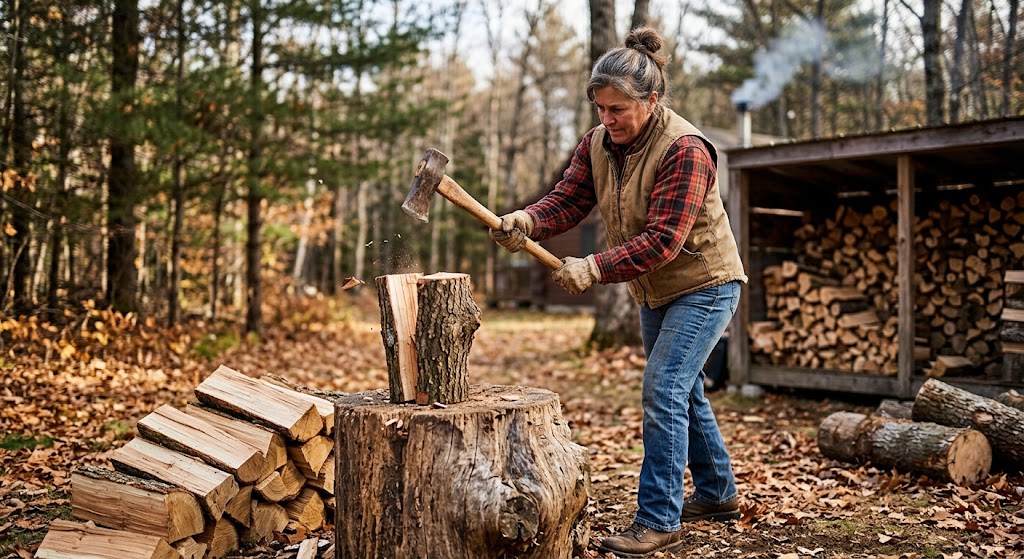
Splitting firewood means using a suitable hand axe to divide small pieces of prepared wood into smaller sections for a campfire.
For Scouts, this is an advanced practical skill because it combines a sharp tool with a significant potential for injury. Scouts’ current guidance provides specific requirements for establishing a dedicated chopping area, keeping untrained people out, using a chopping block and maintaining safe axe technique. A risk assessment must still be completed for the particular activity.
🔴 SAFETY – HIGH RISK
A hand axe can cause serious injury if used incorrectly. Always work in a clearly defined chopping area with appropriate adult supervision and keep everyone else outside the working zone.
Use a stable chopping block on firm, level ground and keep hands, feet and legs away from the axe’s striking path. Never hold the wood while striking it.
Check the axe before use and make sure the head and handle are secure. Wear suitable footwear and avoid loose clothing.
Use controlled strikes rather than excessive force and stop if you become tired or lose concentration. When finished, fit the axe’s protective cover and store it safely.
What You’ll Learn
By the end of the activity, Scouts should understand how to:
The emphasis should be on control and accuracy rather than force.
Equipment
You will need a suitable hand axe, a solid chopping block and dry, suitable firewood.
You should also have appropriate protective footwear and clothing, a safe place to store the axe when it is not being used, and somewhere to stack the split wood.
The axe should be matched to the task. Scouts guidance states that a hand axe can be used to split and trim small pieces of firewood, while larger pieces should be dealt with using more appropriate equipment.
Prerequisites
Scouts should already understand basic axe safety and be able to follow instructions reliably.
They should know the boundaries of an axe working area, how to carry and store an axe safely, and why people must remain outside the designated chopping zone.
This should not be the first activity in which a young person handles an axe.
Instructions
1. Choose the working area
Select firm, level ground away from tents, paths and other camp activities.
Mark out the chopping area clearly. Scouts guidance specifies a radius of at least three axe lengths around the chopping block.
2. Set up the chopping block
Place a stable chopping block in the centre of the working area.
It should be solid enough that it will not tip, roll or move when struck.
3. Inspect the axe
Check that the axe head is secure and the haft is in good condition.
Make sure the cutting edge is appropriate for the task and remove the mask only when the axe is ready to be used.
4. Select the firewood
Choose suitable pieces of dry, sound wood.
Avoid pieces with obvious nails, screws, stones, excessive knots or other hazards. Do not try to split wood that is clearly too large for the hand axe.
5. Position the wood
Place the wood upright on the chopping block.
Keep your hands and feet clear of the intended striking area. Once the wood is positioned, move your supporting hand away before making the cut.
6. Take a controlled stance
Crouch or kneel behind the chopping block, as recommended in Scouts’ axe guidance.
Keep your body positioned so that a missed or glancing strike cannot hit your legs.
7. Make controlled cuts
Aim carefully at the wood rather than trying to swing the axe as hard as possible.
For splitting, controlled angled cuts can gradually open a small V in the wood. Scouts guidance recommends alternating angled cuts rather than striking straight down, which can cause the axe head to bounce.
8. Let the wood split
As the cut develops, allow the existing split to do the work.
Do not keep striking unnecessarily once the wood has separated.
9. Clear the work area
Move split pieces and loose chippings away from the chopping block regularly.
Place usable pieces into the firewood pile and smaller pieces into the kindling pile.
10. Finish safely
When the session ends, stop all axe work before anyone enters the chopping area.
Fit the axe mask or sheath and return the axe to secure storage. Axes should not be left lying around camp or left outside overnight.
Final Tip
Don’t try to win against the wood with brute force. Good axe technique is about positioning, accuracy and controlled strikes. If the wood is resisting, stop and reassess whether the piece is suitable for the axe and the person using it.
🔒Ready to test your survival skills?
Join Survival Guides UK for free, complete challenges, earn badges and increase your Survival Level.
JOIN FREE →
CRAIG BURR
FOUNDER · SURVIVAL GUIDES UK
I'm Craig, the person behind Survival Guides UK. I created SGUK because I wanted somewhere people could learn real outdoor skills in a practical, straightforward way — from lighting a fire and tying knots to navigation, campcraft and everything in between.
You can read more about the story behind SGUK here as well as our approach here.