
SGUK Outdoor Skills Challenge 12: Make a Feather Stick
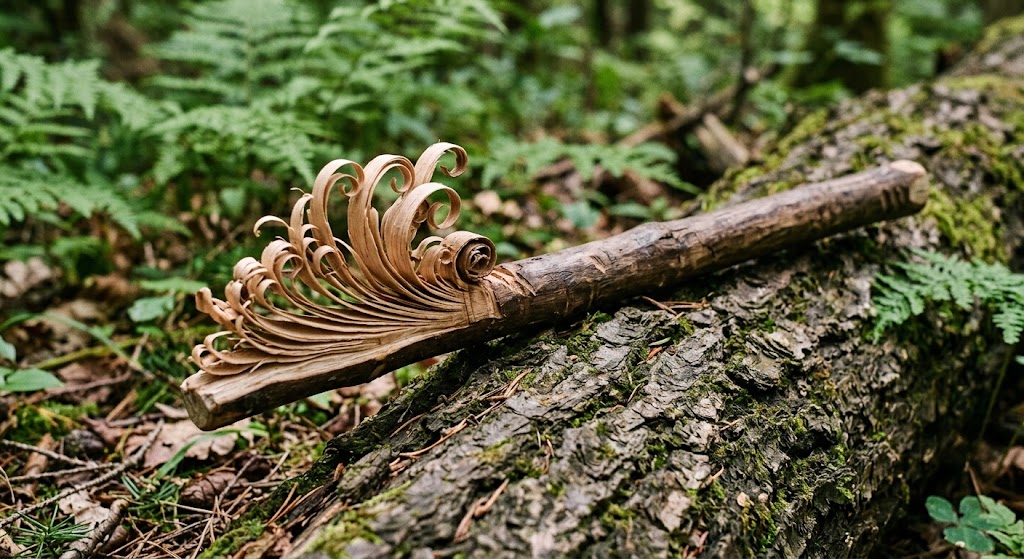
A feather stick is a useful piece of kindling made by shaving thin curls of wood along a stick while leaving those curls attached. The fine curls catch a flame more readily than a thick piece of wood, making a feather stick a handy skill to learn when practising traditional fire preparation.
In the previous challenge, you learned how to identify three common trees. This challenge requires you to actually make something. The trick is not to rush or try to remove lots of wood with each cut. A good feather stick takes patience, a suitable piece of wood and controlled knife work. For this challenge, you’ll make your own feather stick and practise producing a series of thin curls without cutting all the way through them.
Your Challenge
Your task is to make a feather stick with several thin curls of wood attached to the main stick. Focus on control and consistency rather than making the biggest or most impressive-looking example.
Only attempt the knife work if you are confident using a suitable knife safely and are in a place where collecting and working wood is permitted. Beginners should practise under the supervision of a competent adult or instructor.
What You’ll Need
- A suitable fixed-blade bushcraft knife or other appropriate carving knife
- A dry, straight piece of dead wood that you are permitted to collect
- A stable place to sit or work
- A first-aid kit nearby
- Suitable adult supervision if you are inexperienced
Take the Challenge
Start by choosing a straight piece of dry, dead wood that is roughly finger-thick or a little thicker. Softwood can be easier to work for a first attempt, although the type of wood and its condition will affect how easily it shaves. Use only wood you are allowed to collect, such as suitable fallen material in an area where collection is permitted. Don’t cut living branches from trees or shrubs, and avoid wood that is rotten, damp or likely to split unpredictably.
Before you begin, find a stable position and check the space around you. Keep other people well away from your working area, make sure your hands and the wood are dry enough to grip securely, and always cut away from your body and supporting hand. Use a controlled carving motion rather than force. If you are not confident handling a knife, ask an experienced person to demonstrate the technique and supervise your attempt.
Hold the stick securely and make a shallow shaving cut along its surface, starting near one end and drawing the blade carefully along the grain. The aim is to lift a thin curl while leaving it attached at the end, rather than cutting it off completely. Repeat with another cut beside the first, then continue around the stick to build up a collection of curls. Keep each cut shallow and controlled; pressing harder does not necessarily produce better curls, and trying to remove too much wood at once makes the task more difficult.
As you work, pay attention to the shape of the curls. Thin, long curls can help catch a flame, but they don’t all need to look identical. If a curl breaks off, simply move on and try again. You may find that turning the stick slightly between cuts makes it easier to work around the surface without placing your fingers in the path of the blade. Stop if the wood becomes unstable, the knife slips or you feel tired and less focused.
When you have several curls attached, inspect your feather stick. You should be able to see the thin shavings standing away from the central stick, creating a larger surface area than the original piece of wood. Put the knife away safely before handling or photographing your finished work.
Check Your Results
You have completed the practical part of the challenge when you have made a feather stick with several curls still attached to the main piece of wood.
Look at the curls and consider whether they are thin enough to catch a flame more easily than the unshaved stick. If most of the shavings have broken off, think about whether your cuts were too deep or whether you were pushing too hard. Feather sticks take practice, so a rough first attempt is perfectly normal. The important part is learning to control the knife and improve your technique without taking unnecessary risks.
You do not need to light a fire to complete this challenge. If you later choose to use the feather stick for fire lighting, only do so where fires are permitted, in suitable conditions and with the right precautions for safely controlling and extinguishing the fire.
Complete the Challenge
Take a photograph of your finished feather stick, making sure the attached curls are clearly visible. Place the knife safely out of the way before taking the picture, and don’t include unsafe knife handling in your evidence.
How to Submit Your Challenge
- Go to your SGUK member profile.
- Open the Social Activity area.
- Upload your photograph to your activity wall.
- Add the hashtag #SGUKChallenge12.
- Share your post so your evidence can be checked.
Once you’ve shared your evidence and it has been verified, the SGUK Outdoor Skills Challenge 12 is complete and the completed challenges figure will be updated on your profile.
Challenge 12 Checklist
Want to Push Yourself?
If your first feather stick was successful, try making another one and compare the curls. See whether you can make them thinner and more consistent while maintaining safe control of the knife. Don’t set yourself a speed target; careful, repeatable technique is far more valuable than rushing.
You could also learn how feather sticks fit into the wider process of preparing tinder and kindling. Remember that a feather stick is only one part of fire preparation, and the success of a fire also depends on suitable fuel, conditions and safe site selection.
What’s Next?
Making a feather stick develops patience and practical campcraft skills, and it gives you another useful technique to practise as part of your outdoor learning. If you want to build on this challenge, explore our fire-lighting guides and learn how to prepare tinder, organise kindling and manage a small fire safely.
You can also explore the other SGUK Outdoor Skills Challenges to choose your next activity. The challenges can be completed in any order, so keep practising the skills that interest you and build your confidence one step at a time.
Learn. Practise. Master. That’s what the SGUK Outdoor Skills Challenge is all about.
🔒Ready to test your survival skills?
Join Survival Guides UK for free, complete challenges, earn badges and increase your Survival Level.
JOIN FREE →
CRAIG BURR
FOUNDER · SURVIVAL GUIDES UK
I'm Craig, the person behind Survival Guides UK. I created SGUK because I wanted somewhere people could learn real outdoor skills in a practical, straightforward way — from lighting a fire and tying knots to navigation, campcraft and everything in between.
You can read more about the story behind SGUK here as well as our approach here.