Kim’s Game: How to Run an Observation Game
Activity Overview
Difficulty: Easy
Time: 10–20 minutes
Location: Indoors or outdoors
Best for: Small groups, patrols and activity sessions
Skills: Observation, memory, concentration and attention to detail
Kim’s Game is a simple observation and memory game in which participants are shown a collection of objects for a limited time before the objects are covered or removed. They then try to remember as many objects as possible.
The game needs very little equipment and can be adapted for different ages and group sizes. To make it harder, use more objects, reduce the viewing time or ask participants to remember specific details rather than simply naming what they saw.
What You’ll Learn
Kim’s Game helps young people practise:
It is particularly useful as a short activity because it can be prepared quickly and fitted around other camp or outdoor activities.
🟢 SAFETY – LOW RISK
Kim’s Game itself has very few hazards. The main risks come from the surroundings rather than the game.
Use a stable table or suitable surface for the objects and keep small items away from very young participants who could put them in their mouths.
If running the game outdoors, choose a safe, level area and make sure objects cannot become trip hazards.
Equipment
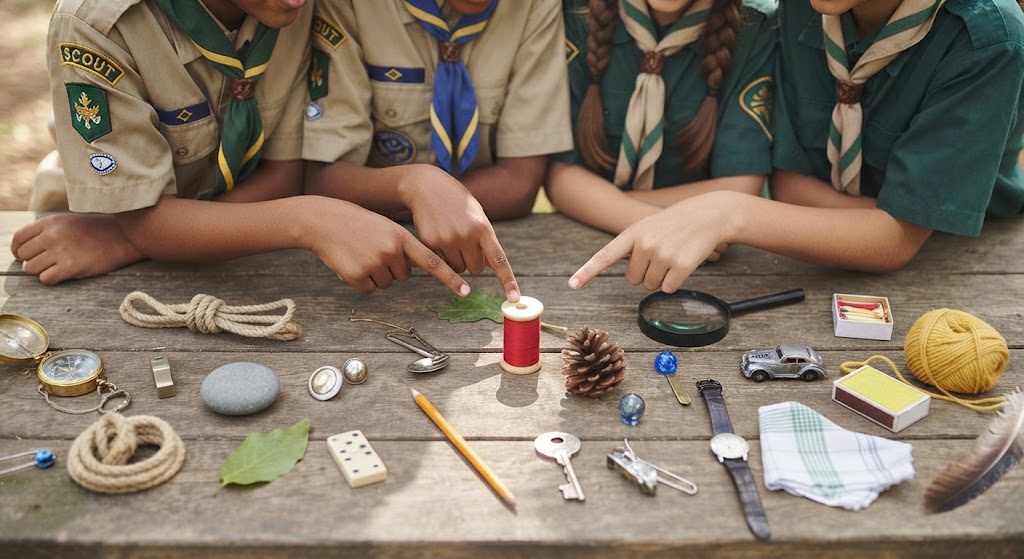
You need a collection of objects that participants can easily see and distinguish from one another.
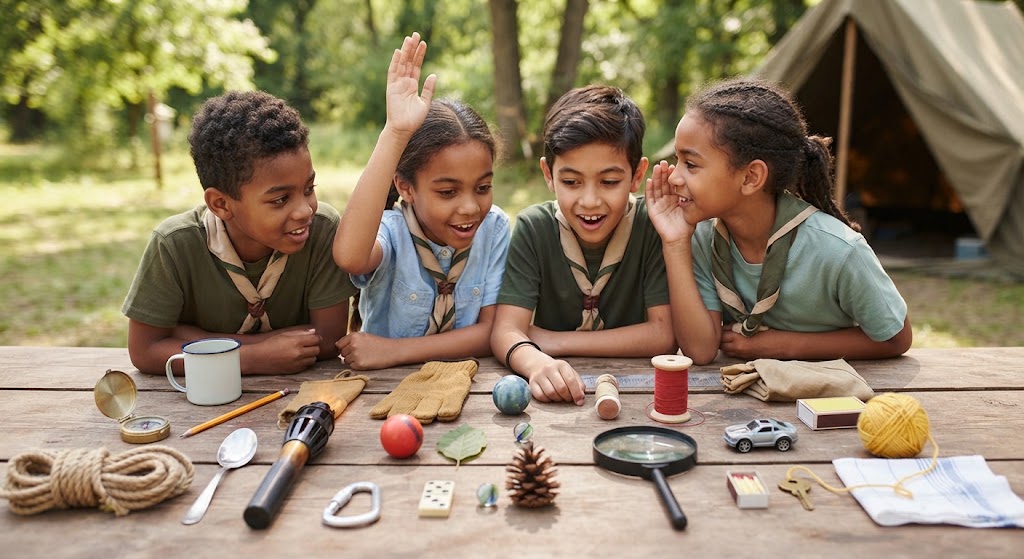
Suitable items might include:
Around 10–15 objects is a good starting point. You can increase the number as the group becomes more experienced.
You will also need a cloth, towel or similar covering and paper and pencils if participants are going to write their answers.
Prerequisites
No previous experience is required.
Before starting, explain that participants should look carefully at the whole collection rather than concentrating on just one or two objects.
For younger participants, use fewer objects and give them longer to observe them. Older participants can be given more objects and less viewing time.
Instructions
1. Select your objects
Choose a collection of objects that are easy to distinguish.
Avoid having too many objects that look almost identical, especially when introducing the game. A mixture of different shapes, sizes, colours and materials makes the activity easier to understand.
For an outdoor or camp-themed version, use familiar items such as camping equipment, knots, natural objects and everyday personal kit.
2. Arrange the objects
Place the objects where everyone in the group can see them.
Spread them out rather than placing everything in a pile. Make sure smaller objects are not hidden behind larger ones.
If the group is large, divide participants into smaller teams so everyone gets a clear view.
3. Give the group time to observe
Tell participants they have a limited amount of time to study the objects.
For a first attempt, give them around one or two minutes.
Encourage them to look at the entire collection. They can move their eyes around the display, but they should not touch or move the objects.
You can tell them in advance that they will need to remember as many objects as possible.
4. Cover the objects
When the observation period ends, cover the entire collection with a cloth or remove the objects from sight.
Do this promptly so participants don’t get extra time to study the display.
Ask everyone to write down as many objects as they can remember.
If the group is young or you want to keep the activity informal, participants can simply call out their answers instead.
5. Check the answers
Uncover the objects and compare them with the participants’ answers.
Award one point for each correctly remembered object if you want to turn the activity into a competition.
Don’t worry about scoring if the aim is simply to practise observation.
You can also ask participants whether they remembered an object’s name, its position or another detail about it.
6. Try the missing-object variation
Once everyone understands the basic game, introduce a simple variation.
Allow the group to observe the objects before covering them. While they are looking away, remove one object.
Uncover the display and ask them to identify what is missing.
Start with one missing object. If the group finds this easy, remove two or three.
This version encourages participants to remember the entire arrangement rather than simply making a list of objects.
7. Change the positions
Another variation is to change the position of objects rather than removing them.
After the first observation period, cover the display and move several objects.
Uncover it and ask participants to identify what has changed.
For example, a mug might have moved from the left side of the display to the right, or two objects might have swapped positions.
This adds spatial awareness to the memory challenge.
8. Ask for specific details
You can make Kim’s Game more challenging without adding more objects.
Instead of asking participants simply to name what they saw, ask questions about specific details.
For example:
This encourages participants to observe deliberately rather than relying on general impressions.
9. Turn it into a team challenge
Divide the group into small teams and give each team the same observation task.
After the objects are covered, allow the teams a short period to agree on their answers.
Give one point for each correct object.
For an additional challenge, give bonus points for correctly remembering the position of an object or a specific detail.
Team play can be useful when the aim is to encourage communication as well as observation.
10. Take Kim’s Game outdoors
Kim’s Game doesn’t need to use a prepared table.
Choose a safe outdoor area and give participants time to observe it.
They might need to remember the position of trees, equipment, signs, paths or other obvious features.
Move the group away and then ask questions about what they saw.
You can also make small changes to a campsite or activity area and challenge participants to identify them.
Keep the area controlled and avoid moving anything that could create a safety problem.
11. Increase the difficulty gradually
There are several straightforward ways to make the game harder:
Reduce the observation time.
Increase the number of objects.
Use objects that are similar in appearance.
Ask participants to remember positions as well as objects.
Introduce several changes between observations.
Ask for specific details rather than general descriptions.
Avoid making the game unnecessarily difficult. The aim is to improve observation skills, not simply produce a low score.
12. Review the activity
Finish by asking participants what helped them remember the objects.
Some may have grouped objects by type, while others may have mentally worked across the display from left to right.
Ask what they found easiest and what they missed.
This is a useful opportunity to explain that good observation is an active process. Deliberately looking for details and creating a mental picture can make information much easier to remember.
Final Tip
The best Kim’s Games use ordinary objects in an interesting setting. Camping equipment, personal kit and natural objects make the activity feel more relevant than a random collection of household items.
Once the basic version becomes easy, don’t just keep adding more objects. Ask participants to remember positions, changes and specific details. That develops a much broader observation skill while keeping the game simple to run.
🔒Ready to test your survival skills?
Join Survival Guides UK for free, complete challenges, earn badges and increase your Survival Level.
JOIN FREE →
CRAIG BURR
FOUNDER · SURVIVAL GUIDES UK
I'm Craig, the person behind Survival Guides UK. I created SGUK because I wanted somewhere people could learn real outdoor skills in a practical, straightforward way — from lighting a fire and tying knots to navigation, campcraft and everything in between.
You can read more about the story behind SGUK here as well as our approach here.