15 First Aid Mistakes to Avoid in an Emergency
Knowing some basic first aid can make a big difference when someone is injured or becomes ill outdoors. However, knowing what not to do is just as important.
In an emergency, people can panic, rush in without thinking or try something they have seen in a film or online. This can sometimes make the situation worse.
The most important rule is to stay calm, make the area safe and get the right help.
Here are some common first aid mistakes to avoid.
1. Putting Yourself in Danger
Before helping someone, look around you.
There could be traffic, unstable ground, falling rocks, fire, deep water, electricity or other hazards nearby. If you get injured as well, there may be two people who need help instead of one.
You should not enter a dangerous area just because someone else is injured.
If the scene is unsafe, move to a safe position and call for help.
This is often called scene safety – checking that the area is safe before approaching the casualty.
2. Panicking
An emergency can be frightening, especially if you have never dealt with one before.
Panic can cause you to forget important steps or make rushed decisions.
Try to slow down and think:
- Is the area safe?
- What has happened?
- Is the person conscious?
- Are they breathing normally?
- What help do we need?
- Who can call the emergency services?
You do not need to know everything. You just need to take sensible steps and get appropriate help.
3. Failing to Call for Help
One of the biggest mistakes is waiting too long before getting professional help.
If someone is seriously injured or unwell, call 999 or 112 in the UK.
This is particularly important if someone:
- Is unconscious or difficult to wake
- Is not breathing normally
- Has severe bleeding
- Has a serious head injury
- Has difficulty breathing
- Has suffered a major burn
- Has a suspected spinal injury
- Has been seriously injured in a fall
- Is having a seizure that does not stop
- Has suddenly become very unwell
If you are unsure whether something is serious, it is better to get advice rather than simply assume everything will be fine.
4. Moving an Injured Person Without a Good Reason
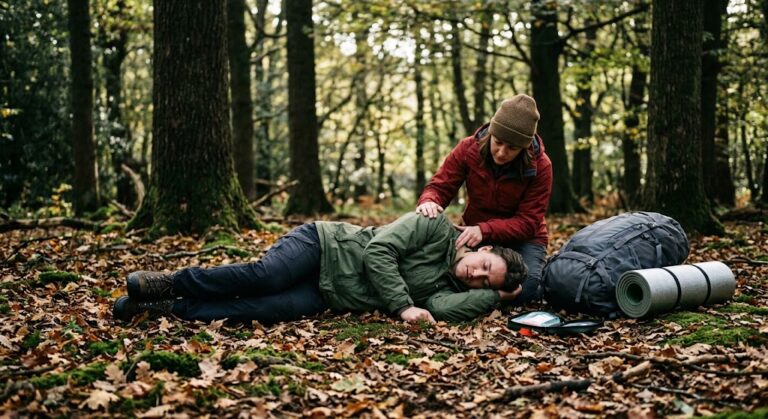
It can be tempting to move someone who has fallen or been injured.
However, unnecessary movement can make some injuries worse, particularly injuries to the spine – the column of bones running down your back that protects the spinal cord.
If the area is safe, leave the person where they are unless you need to move them for an immediate danger.
For example, someone trapped in a dangerous location may need to be moved to safety. Otherwise, wait for appropriate help and avoid unnecessary movement.
5. Giving Someone Food or Drink
It may seem helpful to give an injured person some water or food.
However, this is not always appropriate. Someone who is seriously injured or may need medical treatment could become sick or have problems if they eat or drink.
Unless a trained first aider or emergency professional tells you otherwise, avoid giving food or drink to someone who is seriously injured.
6. Trying to Remove an Object Stuck in a Wound
If something is stuck in someone’s body, such as a large piece of glass or metal, do not pull it out.
Removing it could cause additional bleeding or damage.
Instead, get emergency help and avoid putting pressure directly on the object. If possible, pressure can be applied around it while keeping the object in place.
7. Putting Something in Someone’s Mouth During a Seizure
This is a common myth.
If someone is having a seizure, do not put anything in their mouth. They cannot swallow their tongue, and putting objects or fingers into their mouth could cause injury.
Move nearby dangerous objects away if you can do so safely.
When the seizure stops, check their breathing and stay with them. If they are unconscious but breathing normally, place them in the recovery position if there is no reason not to move them.
A seizure that lasts five minutes or more is a medical emergency. Call 999 or 112 if this happens, or if you are concerned about the person’s condition.
8. Using the Wrong Thing on a Burn
There are plenty of old-fashioned ideas about treating burns, but some can make things worse.
Do not put butter, oils, creams or other household substances on a fresh burn.
For a thermal burn, cool the area under cool running water for at least 20 minutes as soon as possible. Avoid using ice directly on the burn.
Remove nearby jewellery or clothing if it is not stuck to the skin.
Serious burns need urgent medical attention.
9. Putting Yourself at Risk to Stop Bleeding
Severe bleeding needs to be treated quickly, but you still need to protect yourself.
If possible, use gloves or another suitable barrier when dealing with blood.
Apply firm pressure to the wound using a dressing or clean material.
If blood soaks through, add another dressing or material rather than repeatedly removing the first one.
Severe bleeding requires urgent emergency help.
10. Assuming Someone Is Fine Because They Are Talking
Being able to talk does not necessarily mean someone is okay.
A person can be seriously injured while remaining conscious and able to speak.
Look for other signs such as:
- Difficulty breathing
- Confusion
- Pale, cold or clammy skin
- Severe pain
- Heavy bleeding
- Weakness or dizziness
- Changes in behaviour
- Difficulty staying awake
Keep monitoring the person and get appropriate help if you are concerned.
11. Leaving Someone Alone
If someone is seriously injured or unwell, try to stay with them until help arrives, provided it is safe to do so.
You can reassure them, monitor their condition and pass useful information to the emergency services.
If you are in a group, one person can stay with the casualty while another goes for help if there is no phone signal.
In remote areas, make sure someone knows exactly where you are.
12. Forgetting to Check Breathing
After checking that the scene is safe and the person is responsive, you may need to check whether they are breathing normally.
If someone is unresponsive and not breathing normally, call 999 or 112 and start CPR.
CPR stands for cardiopulmonary resuscitation. It uses chest compressions, and sometimes rescue breaths, to keep blood moving around the body when someone’s heart has stopped beating normally.
If an automated external defibrillator (AED) is available, send someone to get it and follow its instructions.
You do not need to be a medical expert to start basic emergency actions when someone is not breathing normally. The emergency call handler can guide you.
13. Doing Something Just Because You Saw It Online
Not every first aid tip on social media is reliable.
You may come across unusual treatments, old myths or advice that only applies to a specific situation.
First aid should be based on reliable training and recognised guidance.
If you have completed first aid training through Scouts or another organisation, keep your skills fresh and follow the procedures you were taught.
14. Forgetting About Shock
After a serious injury, a person can develop shock. In first aid, shock means that the body’s circulation is not providing enough blood and oxygen to vital organs.
Someone experiencing shock may become:
- Pale
- Cold or clammy
- Weak or dizzy
- Thirsty
- Confused
- Very sleepy or restless
Get emergency medical help and keep the person warm with extra clothing or a blanket, while continuing to monitor them.
Do not give them food or drink unless advised by a medical professional.
15. Trying to Do Too Much
You do not have to fix every problem yourself.
Your job in an emergency is to:
- Stay safe.
- Assess what has happened.
- Get help.
- Give appropriate first aid.
- Keep monitoring the casualty.
If you do not know how to deal with something, say so. Getting professional help is far more important than trying to look like you know exactly what you are doing.
First Aid Mistakes: A Quick Checklist
When an emergency happens, remember:
- Stay safe before approaching.
- Stay calm and think clearly.
- Call 999 or 112 when serious help is needed.
- Do not move an injured person unnecessarily.
- Do not put objects in someone’s mouth during a seizure.
- Do not remove objects stuck in serious wounds.
- Do not put butter, oil or ice on a fresh burn.
- Protect yourself from blood where possible.
- Check breathing and be prepared to start CPR if needed.
- Stay with the casualty when it is safe.
- Follow instructions from emergency call handlers and trained first aiders.
Practise Before You Need It
First aid is much easier to remember when you have actually practised it.
Scouts have plenty of opportunities to learn first aid, whether through training sessions, activities or outdoor scenarios.
Practise simple skills such as:
- Calling the emergency services
- Checking responsiveness and breathing
- Putting someone in the recovery position
- Treating minor cuts and grazes
- Applying a dressing
- Recognising when an injury could be serious
- Finding your location using a map and grid reference
It is also worth knowing where the first aid kit is kept on camps, hikes and expeditions.
Final Thoughts
The biggest first aid mistake is often rushing in without thinking.
Stay safe, assess the situation, get help and use the first aid skills you have been taught. You do not need to be a doctor or paramedic to make a useful difference in an emergency.
Good first aid is not about doing something dramatic. It is about doing the right things, avoiding harmful mistakes and getting professional help when it is needed.
🔒Ready to test your survival skills?
Join Survival Guides UK for free, complete challenges, earn badges and increase your Survival Level.
JOIN FREE →
CRAIG BURR
FOUNDER · SURVIVAL GUIDES UK
I'm Craig, the person behind Survival Guides UK. I created SGUK because I wanted somewhere people could learn real outdoor skills in a practical, straightforward way — from lighting a fire and tying knots to navigation, campcraft and everything in between.
You can read more about the story behind SGUK here as well as our approach here.