SGUK Outdoor Skills Challenge 20: Make a Simple Emergency Signal
If you ever need help outdoors, being able to attract attention could make a big difference. Shouting might work when someone is nearby, but your voice can become tired and may not carry as far as you imagine. A whistle or torch can help you send a clearer signal without exhausting yourself.
For the SGUK Outdoor Skills Challenge 20, you’ll learn a recognised distress signal and practise using a simple piece of equipment to communicate that you need help. You’ll also consider how to make yourself easier for rescuers to locate.
Your Challenge
Learn and demonstrate a simple emergency signal using a whistle. You will practise the recognised pattern for attracting attention, explain when to use it and identify a visual alternative for situations where a whistle cannot be heard.
The aim is to understand how to signal for help responsibly. You must never make emergency services believe a real incident is taking place while practising.
What You’ll Need
- A whistle
- A torch as an optional visual signalling device
- A notebook and pen
- A safe, open area where you can practise without alarming other people
Take the Challenge
Step 1: Learn the distress signal
Mountain Rescue England and Wales advises walkers to use six blasts of a whistle in quick succession, repeated after a one-minute interval. The signal can also be made using six torch flashes.
Remember the pattern:
- Give six clear whistle blasts in quick succession.
- Pause for one minute.
- Repeat the signal if you still need help.
- Continue signalling until someone reaches you, even if you hear a response.
This pattern helps distinguish a deliberate distress signal from ordinary sounds. A whistle is generally more effective than repeatedly shouting, and it can help rescuers work out the direction from which a signal is coming.
Step 2: Practise with your whistle
In a suitable, quiet location, practise producing six distinct blasts followed by a pause. Count each blast carefully so that you do not lose track of the pattern.
For this practice, tell anyone nearby what you’re doing first and make sure nobody is likely to mistake your demonstration for a genuine emergency. Never practise distress signals in a way that could trigger an unnecessary rescue response.
Step 3: Make a visual signal
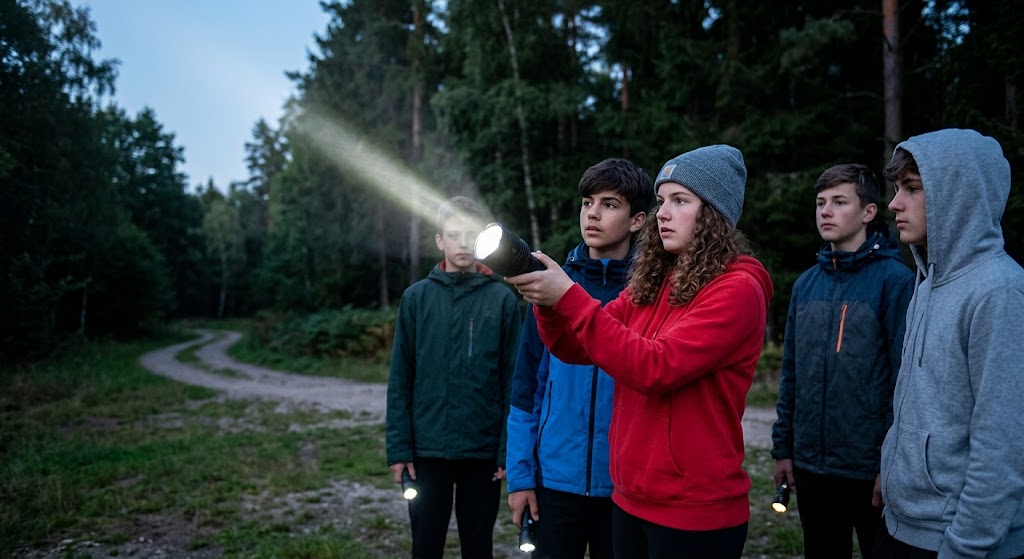
Imagine you are somewhere that a whistle might not be heard clearly. A torch can be used to repeat the six-flash distress signal, particularly when visibility is poor or darkness has fallen.
During daylight, you can also use a brightly coloured jacket or piece of clothing to make yourself more visible. Hold it up or place it somewhere visible from a safe position, without climbing, entering dangerous terrain or leaving a safe location to find a better spot.
A bright object can help rescuers see you, but it should not be confused with a formal distress signal. Always use recognised signals where possible.
Step 4: Decide when to signal
Think about a situation in which you have become lost, someone in your group is injured, or you cannot safely continue your journey. Explain why you might use a whistle or torch, and how you would combine signalling with other actions to get help.
If you have a mobile phone signal and need emergency assistance, call 999 or 112. In a mountain or remote upland emergency in England and Wales, ask for the Police and then Mountain Rescue. Give your location as accurately as possible and follow the call handler’s instructions.
Step 5: Prepare for an emergency
Check that your whistle is easy to reach rather than buried at the bottom of your rucksack. If you carry a torch, make sure it works and that its batteries are charged.
Think about where you could safely wait if you needed help. In many situations, once you have contacted rescuers and given your location, remaining in a safe place helps them find you. Move if your current position becomes dangerous or emergency services instruct you to do so.
Safety
Only practise the signal in a controlled setting where it will not be mistaken for a genuine emergency. Do not use flares, start fires or climb to a high point to attract attention for this challenge.
In a real emergency, do not delay calling for help while trying different signals. Use your phone if possible, give rescuers your location and follow their instructions. If you cannot make a call, use your whistle or another suitable signal repeatedly while conserving your energy and staying as safe and visible as you can.
Check Your Results
Before completing the challenge, make sure you can answer these questions:
- How many whistle blasts are used in the Mountain Rescue distress signal?
- How long should you pause before repeating the signal?
- Why is a whistle often more useful than shouting repeatedly?
- How could a torch help if you needed to signal after dark?
- What should you do if you need emergency assistance and have a working mobile phone?
You should be able to demonstrate the pattern correctly and explain why signalling is only one part of getting help.
Complete the Challenge
To complete Challenge 20, demonstrate the six-blast whistle signal and explain how you would use it in a genuine emergency. You can submit a photograph of yourself with your whistle and a photograph of your written notes showing the correct signal pattern.
You do not need to create a real emergency or make the signal outdoors if doing so could cause confusion. A safe, controlled demonstration is sufficient.
How to Submit Your Challenge
- Go to your SGUK member profile.
- Open the Social Activity area.
- Upload a photograph of your whistle, notes or other evidence to your activity wall.
- Add the hashtag #SGUKChallenge20.
- Share your post for evidence verification.
Once you’ve shared your evidence and it has been verified, the SGUK Outdoor Skills Challenge 20 is complete and the completed challenges figure will be updated on your profile.
Challenge 20 Checklist
Want to Push Yourself?
Ask a friend to stand at a sensible distance in a safe, controlled setting and consider how clearly they can hear your whistle. Do not use a distress pattern where it could be mistaken for a genuine emergency; instead, agree a simple ordinary test signal beforehand.
Then explain three other things you would do if you needed rescuing outdoors, such as sharing your location, staying warm and making yourself visible without moving into hazardous terrain.
What’s Next?
You’ve learnt a simple way to attract attention when you need help outdoors. Revisit SGUK Outdoor Skills Challenge 19: Estimate the Height of a Tree to practise another useful observation skill, then explore the other SGUK Outdoor Skills Challenges and choose another skill to master.
For further guidance, read Mountain Rescue England and Wales’ safety advice, which explains how whistles and torches can be used to signal for help.
Learn. Practise. Master.
That’s what the SGUK Outdoor Skills Challenge is all about.
🔒Ready to test your survival skills?
Join Survival Guides UK for free, complete challenges, earn badges and increase your Survival Level.
JOIN FREE →
CRAIG BURR
FOUNDER · SURVIVAL GUIDES UK
I'm Craig, the person behind Survival Guides UK. I created SGUK because I wanted somewhere people could learn real outdoor skills in a practical, straightforward way — from lighting a fire and tying knots to navigation, campcraft and everything in between.
You can read more about the story behind SGUK here as well as our approach here.