Public Rights of Way UK: Understanding Countryside Paths
Activity Overview
Difficulty: Easy
Time: 15–30 minutes to learn
Location: Countryside, farmland, woodland, villages and rural areas
Best for: Cubs, Scouts, Explorers, Patrol Leaders, walkers and outdoor enthusiasts
Skills: Navigation, map reading, countryside awareness, route planning and responsible access
A public right of way is a route that the public has a legal right to use, subject to the particular rights attached to that route.
In England and Wales, the main types are footpaths, bridleways, restricted byways and byways open to all traffic. They don’t all give the same rights of access.
A public right of way can cross privately owned land. This means that the land itself may be privately owned while the public still has a legal right to use the specified route.
The important thing is to understand which type of route you’re using and what access it provides.
What You’ll Learn
You’ll learn how the main types of public rights of way differ, how to recognise them on maps and signs, and how to use them responsibly.
You’ll also learn why a public footpath doesn’t mean you can freely wander anywhere across the surrounding land.
🟢 SAFETY – LOW RISK
Using a public right of way is generally low risk, but countryside routes can include roads, steep ground, water, livestock, uneven surfaces and other hazards.
A right of way doesn’t guarantee that a route will be easy, dry or free from natural hazards.
Stay alert, follow appropriate signs and use suitable clothing and equipment for the conditions.
Never assume that a legal right to use a route means it is safe to do so without considering current conditions.
Equipment
For basic rights-of-way navigation, a suitable map is the most useful piece of equipment.
A compass or navigation device can also help, particularly where paths are difficult to follow.
For longer walks, carry appropriate clothing, food, water and a charged phone.
Prerequisites
No previous experience is required.
It helps to understand basic map symbols and be able to identify your position on a map.
Before using an unfamiliar route, check current access information and look for any temporary closures or diversions.
Instructions
1. Understand What a Right of Way Means
A public right of way gives people a legal right to pass along a particular route.
It doesn’t normally mean that the surrounding land is open for general access.
For example, if a public footpath crosses a farmer’s field, you have a right to follow the footpath but not necessarily to walk anywhere else around the field.
Stay on the route unless you have another access right or the landowner gives you permission.
2. Learn the Four Main Types
In England and Wales, public rights of way are generally divided into four categories.
Footpath
A public footpath is primarily for walking.
You may also have rights to take certain forms of mobility equipment, and dogs are generally permitted subject to relevant restrictions and responsibilities.
Bridleway
A bridleway can be used on foot and, subject to the applicable rights, by horse riders and cyclists.
Cyclists using bridleways should give way to walkers and horse riders.
Restricted Byway
A restricted byway allows walking, horse riding and cycling, as well as certain other non-motorised uses.
Byway Open to All Traffic
A BOAT is a public right of way that can be used by pedestrians, cyclists, horse riders and motor vehicles, subject to any applicable restrictions.
The fact that a route is legally open to motor traffic doesn’t necessarily mean that driving it will be appropriate in all conditions.
3. Learn the Map Symbols
Rights of way are shown on many Ordnance Survey maps using different coloured and styled lines.
Learning the symbols makes route planning much easier.
Don’t rely on the appearance of a track on the ground alone. A wide-looking track isn’t necessarily a public road, and a narrow path isn’t necessarily a public footpath.
Use the map and local information together.
4. Look for Waymarkers
Waymarkers help you follow rights of way on the ground.
You’ll often see coloured arrows or other signs at junctions and points where the route might not be obvious.
If you’re uncertain which direction to take, stop and check rather than simply following the most obvious-looking track.
5. Follow the Correct Route
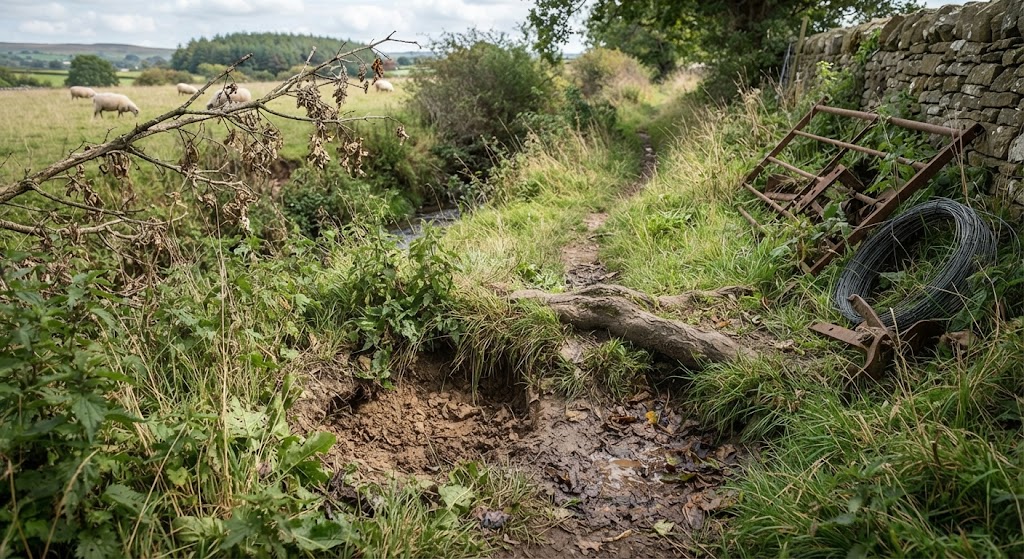
A right of way may pass through a field, woodland or other private land.
Stay on the designated route.
Don’t create shortcuts across fields or around muddy sections unless you know that you have a right to use the alternative route.
Repeated shortcuts can damage crops, vegetation and the ground.
6. Use Gates Responsibly
You may encounter gates, stiles and other access furniture.
Use the appropriate access point rather than climbing over fences.
Leave gates as you find them unless signs or circumstances indicate otherwise.
If a gate was closed, close it behind you. This can be particularly important when livestock are present.
7. Expect Working Countryside
A public right of way doesn’t stop the surrounding land from being used for farming or other legitimate purposes.
You might encounter tractors, livestock, machinery or temporary agricultural work.
Give machinery plenty of room and follow reasonable instructions where necessary for safety.
Don’t interfere with farming equipment or livestock.
8. Give Livestock Space
Livestock may be present directly alongside or across a public right of way.
Don’t approach, feed or deliberately disturb animals.
Be especially cautious around cattle with calves and when walking with dogs.
If livestock are creating a genuine safety problem, don’t put yourself at unnecessary risk simply because the route is technically a right of way.
9. Understand Temporary Closures and Diversions
A right of way can sometimes be subject to a temporary closure or diversion.
Look for notices and follow official diversions rather than ignoring them.
A diversion may be introduced because of a safety issue, construction, farming operation or other temporary circumstance.
Don’t assume that a route shown on an old map is necessarily available in exactly the same way today.
10. Don’t Confuse a Track With a Right of Way
A visible track isn’t automatically a public right of way.
It could be a private farm track, permissive path or other route.
Similarly, a public footpath may not look like a conventional path at all.
Use reliable mapping and local information when planning your route rather than judging access solely from what you can see on the ground.
11. Understand Permissive Paths
A permissive path is different from a public right of way.
It is a route that a landowner or land manager allows people to use, usually under specific conditions.
The permission can sometimes be withdrawn or altered, unlike a recorded public right of way.
Follow any signs or conditions attached to a permissive route.
12. Don’t Assume Every Open Space Is a Right of Way
An open field, woodland or hillside isn’t automatically available for anyone to cross.
There may be a public right of way, access land, a permissive route or no public access at all.
Check before leaving the marked route.
This is particularly important when navigating with a group, because one person taking a shortcut can quickly result in everyone following.
13. Respect Other Users
Public rights of way are shared spaces.
Walkers may meet cyclists, horse riders, dog walkers and people working on the land.
Be courteous and make room where appropriate.
If you’re travelling as a large group, avoid blocking narrow paths and be particularly aware of other users approaching from either direction.
14. Look After the Route
Avoid causing unnecessary damage.
Don’t deliberately widen paths, damage vegetation, leave litter or create new tracks.
If a path is muddy, consider the environmental impact of repeatedly walking around the edge and making the route wider.
Take your rubbish home and leave gates and access points as you found them.
15. Know That Rights Differ Across the UK
The term “public right of way” is particularly important in England and Wales, where recorded rights of way have specific legal categories.
Scotland has a different system, with extensive rights of responsible access under the Scottish outdoor access framework.
Northern Ireland has its own access laws and arrangements.
Don’t assume that an England or Wales footpath symbol means exactly the same thing everywhere in the UK.
Using Rights of Way for Navigation
Public rights of way are particularly useful when planning walks because they provide established routes through the landscape.
When planning a route, identify the rights of way on your map and look for junctions where navigation could become difficult.
Pay particular attention when a path changes direction, crosses a road, passes through a field or joins another track.
A route that looks straightforward on a map can become confusing on the ground, so navigation skills still matter.
Public Rights of Way and Groups
Large groups should take extra care when using narrow paths.
Keep the group together where appropriate without blocking other users.
Before setting out, make sure everyone understands basic countryside etiquette, particularly around gates, livestock, roads and other path users.
For younger groups, explain that following a public footpath means following the route, not simply heading in the general direction shown on the map.
Public Rights of Way and Dogs
Dogs are generally allowed on public rights of way, but owners have responsibilities and additional restrictions can apply.
Keep dogs under control, particularly around livestock and wildlife.
Follow local signs about leads and seasonal restrictions.
A dog should never be allowed to chase livestock.
Final Tip
A public right of way gives you the right to use a particular route, not automatically the right to roam across everything surrounding it.
When walking in the countryside, remember:
Know the route. Follow the route. Respect the land.
Check your map, use the correct access, leave gates as you find them, give livestock and other users space, and follow any current signs or diversions.
🔒Ready to test your survival skills?
Join Survival Guides UK for free, complete challenges, earn badges and increase your Survival Level.
JOIN FREE →
CRAIG BURR
FOUNDER · SURVIVAL GUIDES UK
I'm Craig, the person behind Survival Guides UK. I created SGUK because I wanted somewhere people could learn real outdoor skills in a practical, straightforward way — from lighting a fire and tying knots to navigation, campcraft and everything in between.
You can read more about the story behind SGUK here as well as our approach here.