Knives and Tool Safety for Scouts
Learning to use outdoor tools can be an important part of developing practical Scout skills.
Knives, saws and other hand tools can help Scouts learn about woodcraft, campcraft, shelter building and practical problem-solving. They also introduce risks that need to be taken seriously.
Good tool safety isn’t about being afraid of tools.
It is about understanding what a tool is designed to do, using it correctly, knowing when you need help and taking responsibility for what happens around you.
The safest Scout is not necessarily the person who can use the most tools.
It is the person who knows when, where and how a tool should be used — and when it shouldn’t be used at all.
Why Tool Safety Matters
Knives and other cutting tools are designed to cut.
That means they can cause serious injuries if they are used carelessly, incorrectly or without suitable supervision.
Outdoor environments can make this more challenging.
Ground may be uneven.
Other people may be moving around.
Weather can affect grip and visibility.
A Scout may become tired or distracted.
Safe tool use therefore starts with controlling the environment as well as handling the tool itself.
Choose the Right Tool
The correct tool depends on the job.
A knife isn’t automatically the best tool simply because it can perform several tasks.
Likewise, a saw, axe or other tool should only be used when it is appropriate for the activity.
Using the right tool makes the task easier and reduces the temptation to force, misuse or improvise with equipment.
Before starting, ask:
“What job am I trying to do, and what is the safest suitable tool for it?”
Know Your Tool
Before using an unfamiliar tool, Scouts should understand how it works.
They should know:
What it is designed for.
Where the cutting or working edge is.
How it should be held.
How it should be carried.
How it should be passed, if passing is permitted.
How it should be stored.
What its main hazards are.
A short demonstration from a suitably competent leader can prevent many avoidable mistakes.
Create a Safe Working Area
One of the most important tool-safety principles is creating enough space.
A Scout using a cutting tool should have a clear working area.
Other Scouts shouldn’t be walking through it.
Equipment shouldn’t be scattered around their feet.
The ground should be suitable for the task.
Before starting, look around.
Ask:
“If the tool slips or moves unexpectedly, where could it go?”
This helps Scouts think about consequences rather than simply concentrating on the tool.
Keep Other People at a Safe Distance
Never assume that people nearby are paying attention.
A Scout using a knife or saw needs enough space to work without another person entering the working area.
The same applies when carrying or putting away tools.
Leaders should establish clear boundaries for tool activities and make sure Scouts understand them before tools are issued.
Sit Down for Appropriate Knife Work
For suitable activities, controlled seated work can provide a stable working position.
A Scout should be comfortably positioned with enough space around them and should avoid placing their body in the path of the cutting tool.
The exact technique should be demonstrated by the responsible leader for the particular tool and activity.
If a Scout feels unstable or uncomfortable, they should stop rather than trying to continue.
Keep the Cutting Direction Controlled
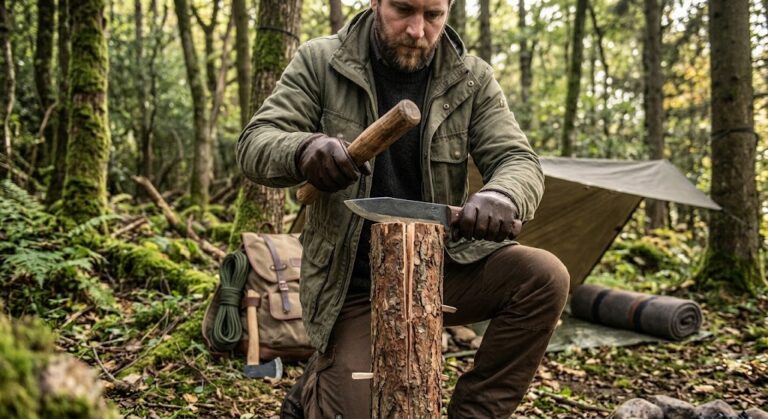
A basic principle of knife safety is to keep the cutting action controlled and away from the body.
Scouts should never rush a cut.
Small, controlled movements are generally preferable to trying to remove a large amount of material in one movement.
If something isn’t cutting easily, don’t simply apply more force.
Stop and reassess the task.
The tool may be unsuitable, damaged or being used incorrectly.
Don’t Test a Blade With Your Finger
A sharp tool should never be tested by running a finger along its edge.
Scouts should learn to treat every blade as capable of causing injury.
Visual inspection and appropriate handling are safer ways to identify whether a tool is in suitable condition.
Keep Tools Sharp and Well Maintained
It might seem strange that a sharp knife can be safer than a blunt one.
A poorly maintained tool may require excessive force, increasing the chance of slipping.
However, sharpening and blade maintenance should only be carried out by people who have been appropriately trained and supervised.
Scouts should never assume that they should sharpen a knife simply because it doesn’t seem to cut well.
A tool that needs maintenance should be reported to the responsible adult.
Carry Tools Safely
Tools should be carried in a way that prevents accidental contact with the working edge.
Follow the specific carrying method taught by the leader for the tool being used.
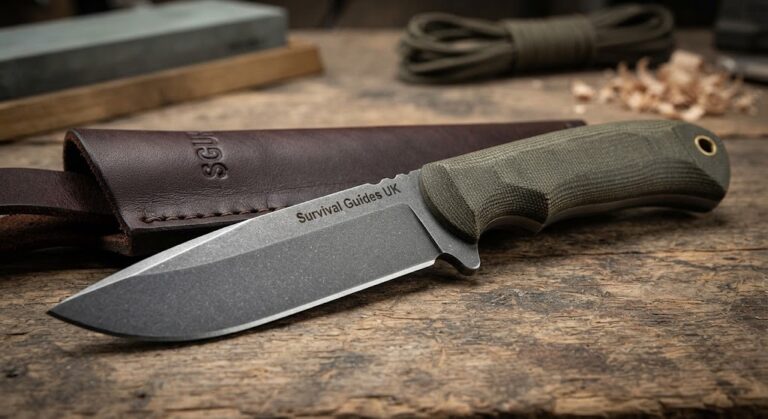
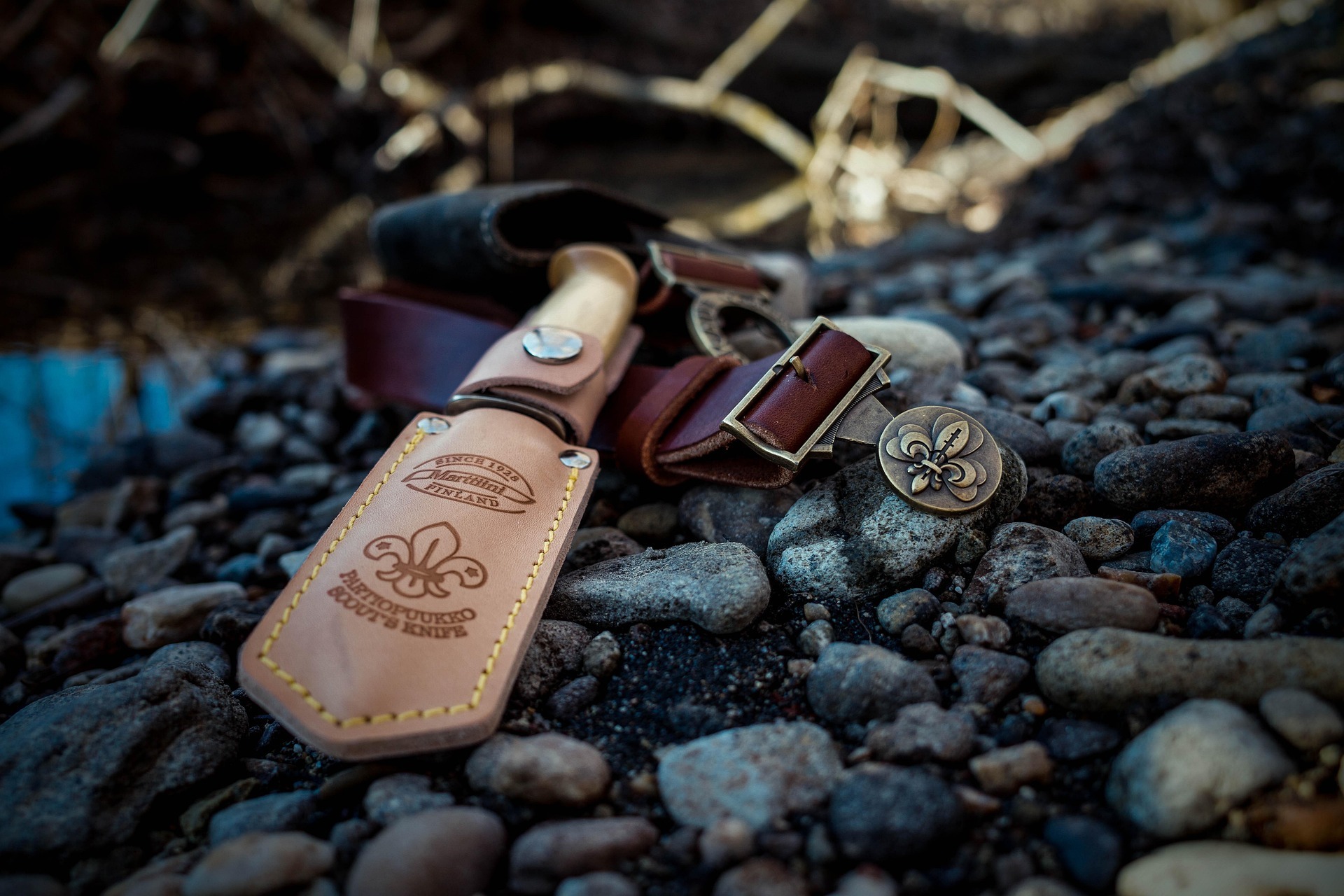
Knives should have suitable protection when being transported or stored.
Never walk around swinging, waving or playing with a knife or other tool.
The tool is being carried because it has a job to do.
Once that job is finished, it should be safely put away.
Passing Tools
Where a tool needs to be passed to another person, Scouts should follow the method demonstrated by their leader.
The safest option may sometimes be to put the tool down securely and allow the other person to pick it up.
Never throw a tool.
Never toss a knife or other sharp tool from one person to another.
If you are unsure how a tool should be passed, ask.
One Tool, One User
During many Scout activities, it is sensible for one person to use a tool at a time.
This reduces distractions and makes it easier for the leader to see what is happening.
Scouts waiting for their turn should remain outside the designated working area.
They should never crowd around someone who is using a cutting tool.
Don’t Distract Someone Using a Tool
A simple conversation can wait.
Never deliberately distract someone who is using a knife, saw or other potentially hazardous tool.
If you need their attention, follow the leader’s instructions for safely stopping the activity first.
The same principle applies to practical jokes.
There should be no pushing, grabbing, shouting unexpectedly or other behaviour intended to surprise someone while they are working.
Put Tools Down Safely
A tool should never be left somewhere that another person might accidentally step on or pick it up.
When a Scout has finished using a tool, it should be placed in the designated safe location.
Don’t leave tools hidden under leaves, on the ground or mixed into other equipment.
A good rule is:
If you’re finished with it, put it away.
Tool Storage
Knives and other sharp tools should be stored securely when they are not being used.
Use appropriate sheaths, guards, cases, toolboxes or storage systems where required.
Group equipment should be returned to its designated storage location after an activity.
Leaders should ensure that access to tools is appropriate for the age, ability and experience of the Scouts involved.
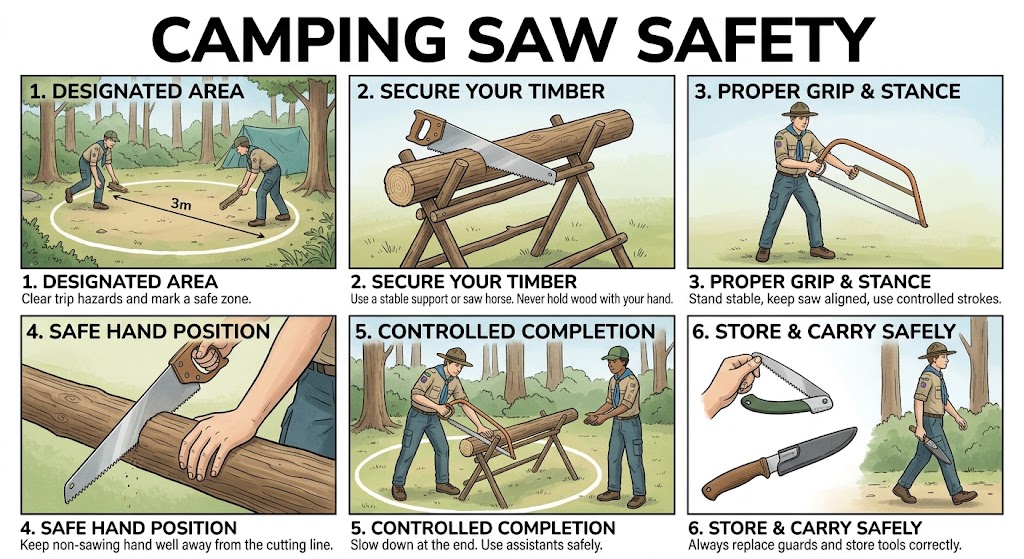
Saws Need Their Own Rules
A saw may appear less dangerous than a knife because the cutting action is different.
It can still cause serious injuries.
Scouts should be taught how to hold and use the particular saw being provided.
The material being cut should be secure.
Other Scouts should remain clear of the working area.
The saw should be carried with appropriate protection and stored safely after use.
Axes and Other Larger Tools
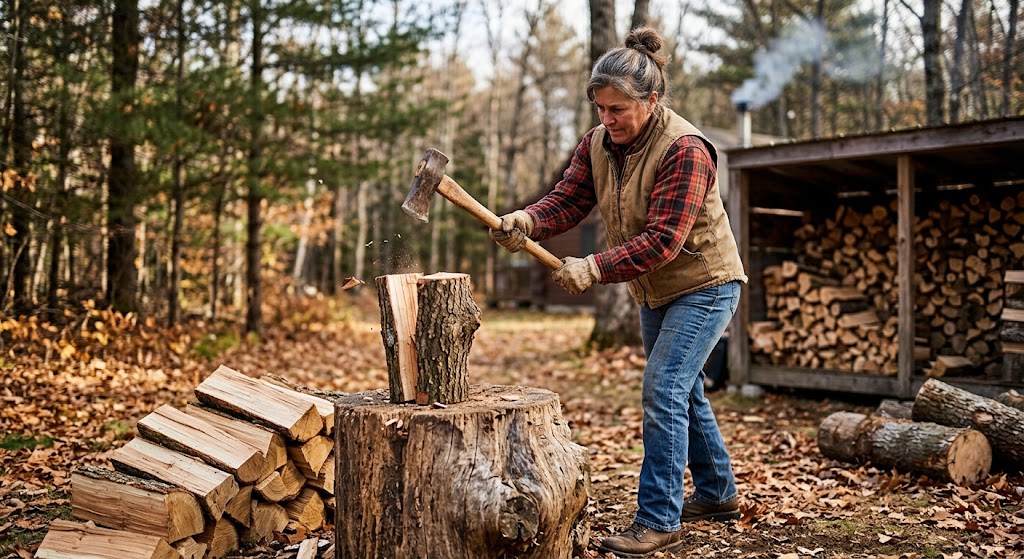
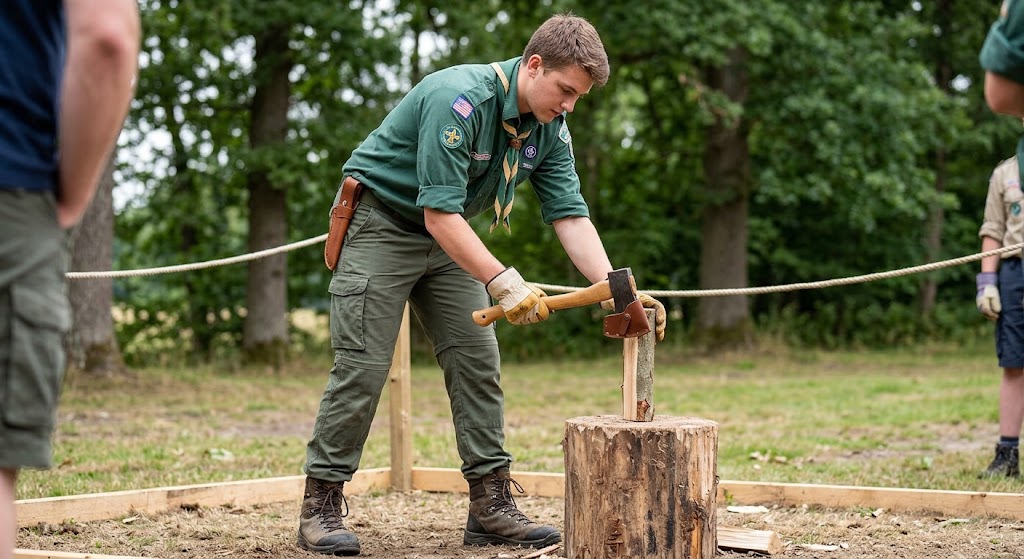
Axes and larger cutting tools require additional space, control and supervision.
They should only be introduced when appropriate for the Scout section, activity and individual experience, and in accordance with the arrangements of the organisation running the activity.
A larger tool isn’t automatically a better tool.
For many Scout activities, a smaller tool may be sufficient.
Check the Tool Before Use
Before using a knife or other tool, check its condition.
Look for:
Damage.
Loose handles.
Cracked components.
Excessive rust or corrosion.
Damaged guards or sheaths.
Loose fittings.
Other signs that it may not be suitable for use.
If something doesn’t look right, don’t use it.
Tell the leader.
Check the Material Too
Tool safety isn’t only about the tool.
The material being worked on can also introduce hazards.
Wood may have nails, screws or hidden defects.
Branches may move unexpectedly.
Timber can split.
Some materials shouldn’t be cut with particular tools.
Before starting, inspect what you’re working with and follow the instructions provided for the activity.
Never Use a Tool as a Toy
Knives and tools aren’t toys.
They shouldn’t be used for:
Showing off.
Playing games.
Pretending to fight.
Throwing.
Testing someone’s reaction.
Making unnecessary cuts.
Trying to impress friends.
If the tool isn’t needed for the activity, it should be safely stored.
Don’t Rush
Many tool-related accidents happen when someone becomes careless or hurried.
There is rarely a good reason to rush an outdoor skills task.
Take your time.
Concentrate on what you’re doing.
Keep the working area clear.
If you become tired or distracted, stop and tell the leader.
What If You Drop a Tool?
Don’t try to catch a falling knife or tool.
Move away and let it fall.
Once it has stopped moving, follow the appropriate procedure for retrieving it.
Trying to catch a falling sharp tool can turn a simple accident into a serious injury.
What If You Cut Yourself?
Even a small cut should be taken seriously during a Scout activity.
Stop using the tool immediately and tell the supervising adult.
The responsible adult can assess the injury and follow the appropriate first-aid arrangements.
Don’t continue using the tool because the injury appears minor.
What If You See Unsafe Tool Use?
Scouts should feel comfortable speaking up if they see something unsafe.
You can say:
“Can we stop for a second?”
or tell the supervising adult.
Safety is everyone’s responsibility.
A Scout shouldn’t feel embarrassed about asking someone to stop if they believe there is a problem.
Tool Safety and Different Scout Ages
The tools and activities used should be appropriate for the age, development, experience and abilities of the Scouts taking part.
Younger sections may focus on recognising tools, understanding boundaries and carrying out simple supervised practical tasks.
Older Scouts may be able to take on more responsibility as their experience develops.
Progression should be based on competence rather than simply age.
A Scout who is confident isn’t necessarily a Scout who is ready to use a more hazardous tool.
Adapt Activities for Individual Needs
Some Scouts may need additional support when using outdoor tools.
Consider physical ability, coordination, concentration, confidence, communication needs and previous experience.
The activity can often be adapted without removing the learning opportunity.
The important thing is that every Scout has a safe and meaningful way to participate.
Leaders Set the Example
Scouts learn a great deal by watching adults.
Leaders should demonstrate calm, deliberate tool handling.
Don’t throw tools down.
Don’t leave equipment lying around.
Don’t rush.
Don’t use damaged equipment.
Don’t ignore small safety issues.
If leaders consistently model good habits, Scouts are much more likely to adopt them.
Make Tool Safety Part of the Activity
Tool safety doesn’t need to be a long lecture before every session.
A practical demonstration followed by a few clear rules is often more effective.
Before handing out tools, establish:
Where Scouts will work.
What tool they are using.
What the tool is for.
What the main hazards are.
What happens when they finish.
Then supervise the activity and correct unsafe habits early.
A Simple Tool Safety Routine
A useful routine for Scouts is:
Check the tool.
Check your working area.
Check the material.
Use the tool correctly.
Stay focused.
Stop when you’re finished.
Clean and store the tool safely.
With practice, these steps become automatic.
Safety
Knives, saws, axes and other cutting tools can cause serious injury and should only be used as part of activities that are appropriate for the Scout section, individual participants and the equipment available.
Activities involving potentially hazardous tools should be planned and supervised by responsible adults with appropriate knowledge, experience and training.
Follow the relevant guidance, policies and procedures of the organisation running the activity.
Use tools only for their intended purpose and according to the manufacturer’s instructions where applicable.
Establish a clear working area and keep other participants at a safe distance.
Damaged or defective tools should be removed from use.
Sharp tools should be carried, stored and transported using suitable protection.
Scouts should be taught how to respond if a tool is dropped, damaged or causes an injury.
Never allow throwing, horseplay or deliberate distraction while tools are being used.
The level of supervision should reflect the activity, equipment, environment and individual needs of the Scouts taking part.
Learning Outcomes
Learning about knives and tool safety can help Scouts:
Leader Notes
Tool activities work best when safety is treated as part of the practical skill rather than a separate lecture.
Before the activity begins, demonstrate the tool and establish the boundaries.
Keep the number of Scouts using tools at one time appropriate to the available supervision and working space.
For younger Scouts, focus on simple rules, controlled activities and recognising when they need help.
With older Scouts, gradually introduce greater responsibility as competence develops.
Don’t assume that previous experience means a Scout automatically understands a different tool.
A knife from one manufacturer may behave differently from another. A different saw may require a different technique. A new environment may introduce completely different hazards.
Always teach the specific equipment being used.
Final Thought for Scouts
A good outdoor skills person isn’t someone who simply knows how to use a knife or saw.
They know when to use it.
They know when not to use it.
They look after their equipment.
They think about the people around them.
And they stop when something doesn’t feel right.
Learning tool skills is about much more than cutting wood.
It is about concentration, responsibility, patience and good judgement.
Those are skills that will be useful long after the tool has been put away.
🔒Ready to test your survival skills?
Join Survival Guides UK for free, complete challenges, earn badges and increase your Survival Level.
JOIN FREE →
CRAIG BURR
FOUNDER · SURVIVAL GUIDES UK
I'm Craig, the person behind Survival Guides UK. I created SGUK because I wanted somewhere people could learn real outdoor skills in a practical, straightforward way — from lighting a fire and tying knots to navigation, campcraft and everything in between.
You can read more about the story behind SGUK here as well as our approach here.