SGUK Outdoor Skills Challenge 70: Make a Signal Mirror
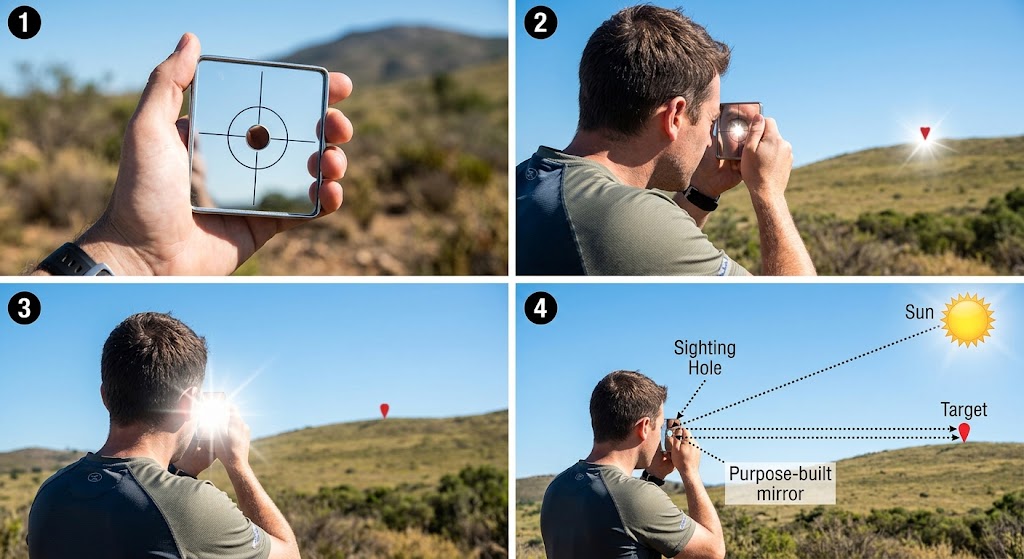
A signal mirror can help you attract attention over a considerable distance when sunlight is available. Purpose-made signalling mirrors are best, but you can explore the basic principle with a small reflective surface and practise directing a flash of light towards a chosen target.
Your Challenge
Make a simple signal mirror and demonstrate that you can use reflected sunlight to direct a visible flash towards a target.
This is a practice activity, not a replacement for carrying proper emergency signalling equipment. Never direct reflected sunlight into anyone’s eyes, towards road users or at aircraft.
What You’ll Need
- A small, lightweight mirror
- A piece of stiff card to make a protective backing
- Tape or suitable adhesive
- Scissors
- A clearly visible target some distance away
- A pencil and notebook to record your results
A purpose-made signalling mirror with an aiming hole is preferable if you have one. Avoid broken glass, sharp-edged metal or improvised reflective materials that could cause injury.
Take the Challenge
Step 1: Prepare your mirror
If using a small mirror, cut a piece of card slightly larger than it and attach the mirror securely to the backing. Cover or protect any sharp edges. Keep the reflective surface clean and avoid touching it unnecessarily.
If you have a purpose-made signalling mirror, use it as supplied rather than modifying it.
Step 2: Choose a target
Find a stationary target in an open area, such as a marker on a fence or a post. Choose somewhere away from roads, windows and other people. Make sure the sun is shining and that you can see the target clearly.
Step 3: Find the reflected light
Hold the mirror securely and angle it until sunlight reflects onto a nearby surface. Move the mirror slowly and observe how the reflected patch of light moves as you change the angle.
Step 4: Aim towards your target
Keep the target in view and gradually adjust the mirror so the reflected light reaches the target area. If your signalling mirror has an aiming hole, follow its instructions. With a plain mirror, you may need several attempts to judge the correct angle.
Never look directly at the sun or deliberately shine the reflection into anyone’s eyes.
Step 5: Practise a signal
Make three controlled attempts to direct the reflected light towards your target. Record how many times you successfully reach the target area. If sunlight is unavailable, complete the mirror-making part and return to the aiming exercise when conditions allow.
Step 6: Understand when to use it
A mirror is useful only when sunlight and a suitable line of sight are available. In an emergency, use other available signalling methods as well, such as a whistle, a torch or a personal locator beacon where appropriate. Do not delay contacting emergency services to practise signalling.
Check Your Results
Ask yourself:
- Is your mirror secure and safe to handle?
- Could you move the reflected light deliberately?
- How many of your three attempts reached the target area?
- Can you explain why a signal mirror is less useful in darkness, thick cloud or dense woodland?
- Can you name another way to attract attention in an emergency?
If aiming proved difficult, practise at a shorter distance before trying again.
Complete the Challenge
To complete this challenge, you must:
- Make a simple signal mirror with a protected backing, or prepare a purpose-made signalling mirror.
- Practise directing reflected sunlight towards a stationary target.
- Make three attempts and record your results.
- Explain when a signal mirror is useful and identify at least one alternative signalling method.
How to Submit Your Challenge
Submit your evidence
- Go to your SGUK member profile.
- Open Social Activity.
- Upload a photograph of your completed mirror and practice target to the activity wall.
- Add the hashtag #SGUKChallenge70.
- Share it for verification.
Include the number of successful attempts in your post. Do not photograph or direct reflected light at other people to provide evidence.
Challenge 70 Checklist
Want to Push Yourself?
Try the exercise from a different distance or angle, provided the area remains safe. Compare your results and see whether you can direct the reflection more accurately.
You could also research recognised emergency signalling equipment and decide what you would carry on your next walk or camping trip.
What’s Next?
If you haven’t completed SGUK Outdoor Skills Challenge 69: Learn How to Throw a Rescue Line from the Shore, you can try that challenge next. You can complete SGUK Outdoor Skills Challenges in any order, so choose whichever skill you want to develop.
Once you’ve shared your evidence and it has been verified, the SGUK Outdoor Skills Challenge 70 is complete and the completed challenges figure will be updated on your profile.
Learn. Practise. Master.
That’s what the SGUK Outdoor Skills Challenge is all about.
🔒Ready to test your survival skills?
Join Survival Guides UK for free, complete challenges, earn badges and increase your Survival Level.
JOIN FREE →
CRAIG BURR
FOUNDER · SURVIVAL GUIDES UK
I'm Craig, the person behind Survival Guides UK. I created SGUK because I wanted somewhere people could learn real outdoor skills in a practical, straightforward way — from lighting a fire and tying knots to navigation, campcraft and everything in between.
You can read more about the story behind SGUK here as well as our approach here.