Printable Knot Guide – 12 Essential Knots for Scouts & Outdoor Skills
Knowing how to tie a few reliable knots is a valuable outdoor skill.
From securing a rope to a post to creating a fixed loop or joining two ropes together, the right knot can make camping, Scouting, hiking and other outdoor activities much easier.
We’ve created this free printable knot guide as a quick reference for beginners and anyone wanting to refresh their rope skills.
Download The Free Knot Guide
Restricted Content
Members Only
Join Survival Guides UK for free to access and download this resource.
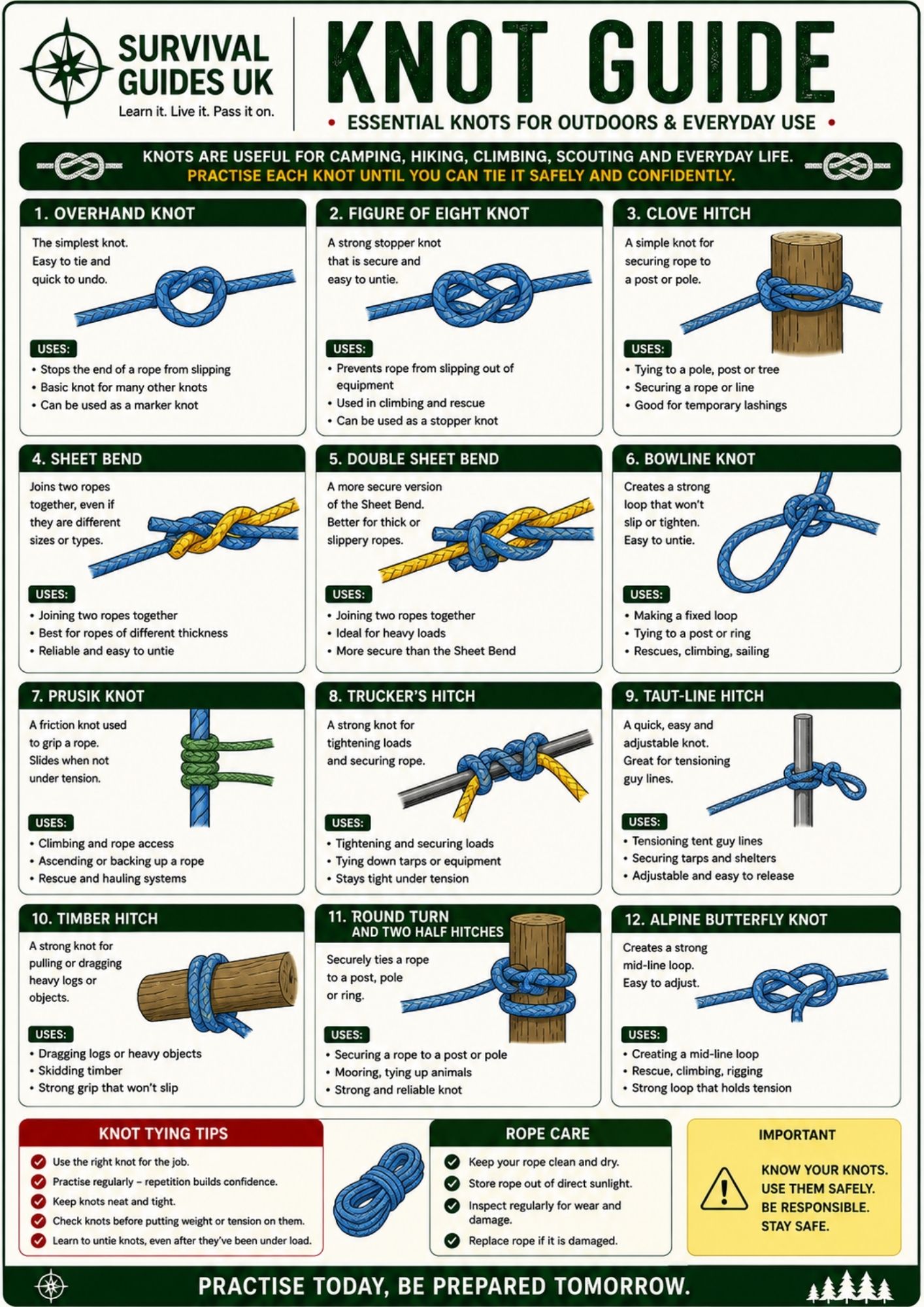
JOIN FREE →The printable contains 12 useful knots, with illustrations showing the finished knot alongside a simple explanation of what each knot is commonly used for.
Print it on A4 paper and keep it with your camping equipment, Scout resources, campcraft notes or outdoor skills folder.
12 Knots to Learn
1. Overhand Knot
The Overhand Knot is one of the simplest knots to learn.
It can be used as a basic stopper knot and is also useful when learning the foundations of other knots.
Common uses:
- Creating a simple stopper
- Marking a rope
- Basic rope work
- Learning the fundamentals of knot tying
2. Figure Eight Knot
The Figure Eight is a useful stopper knot and is generally easier to untie after being loaded than a simple overhand knot.
It is an important knot to recognise and learn when developing rope skills.
Common uses:
- Rope stopper
- Preventing a rope end passing through an opening
- General rope work
3. Clove Hitch
The Clove Hitch is useful for temporarily securing a rope to a post, pole or similar object.
It is particularly useful in Scouting and pioneering activities.
Common uses:
- Securing rope to a pole
- Temporary lashings
- Campcraft
- Pioneering
Always consider whether the Clove Hitch is appropriate for the load and application; it can loosen under some loading conditions.
4. Sheet Bend
The Sheet Bend is designed for joining two ropes together, including ropes of different diameters.
It’s a useful knot to know when a single rope isn’t long enough for a particular task.
Common uses:
- Joining two ropes
- Connecting ropes of different sizes
- General campcraft
5. Double Sheet Bend
The Double Sheet Bend provides an alternative way of joining two ropes and can be useful when working with ropes of different thicknesses.
Common uses:
- Joining ropes
- Thicker or slippery ropes
- General rope work
As with any knot, dress and set it correctly before putting it under load.
6. Bowline
The Bowline creates a fixed loop that generally does not tighten around an object when properly tied and loaded.
It’s one of the best-known utility knots and is an excellent knot for Scouts and outdoor enthusiasts to learn.
Common uses:
- Creating a fixed loop
- Attaching a rope to an object
- General outdoor rope work
Safety: A bowline should be properly dressed and secured, and the working end should have an adequate tail.
7. Prusik Knot
The Prusik is a friction hitch that grips another rope when loaded and can slide when unloaded.
It has specialist applications in climbing and rope systems.
Common uses:
- Rope-access systems
- Climbing applications
- Friction hitches
Important: Prusik knots are part of technical rope systems. They should not be treated as a substitute for proper climbing or rescue training.
8. Trucker’s Hitch
The Trucker’s Hitch is commonly used to create a tensioning system for securing loads.
It can be particularly useful around camp when tying down equipment.
Common uses:
- Tensioning ropes
- Securing loads
- Tying down equipment
- Campcraft
9. Taut-Line Hitch
The Taut-Line Hitch provides an adjustable attachment point and is traditionally useful for tensioning guy lines.
Common uses:
- Tent guy lines
- Tarps
- Shelters
- Adjustable tensioning
Always check the knot regularly, particularly if the line is important to the stability of a shelter.
10. Timber Hitch
The Timber Hitch is designed for attaching a rope to a log or similar object.
It is particularly useful for moving or dragging suitable objects and has applications in pioneering and campcraft.
Common uses:
- Dragging logs
- Moving timber
- Pioneering
- Temporary attachment to cylindrical objects
11. Round Turn and Two Half Hitches
This knot combination provides a useful way to secure a rope to a post, pole or ring.
The round turn takes some of the load while the half hitches secure the working end.
Common uses:
- Securing ropes
- Mooring
- Campcraft
- General outdoor use
12. Alpine Butterfly
The Alpine Butterfly creates a fixed loop in the middle of a rope.
Unlike a bowline, the loop can be created without needing access to the rope’s end.
Common uses:
- Creating a mid-line loop
- Rope systems
- Isolating a damaged section of rope in appropriate applications
- General rope work
For climbing, rescue or load-bearing applications, use only techniques you have been properly trained to use.
How to Get Better at Tying Knots
The easiest way to learn knots is through practice and repetition.
Start with a short length of rope and practise each knot until you can tie it without constantly referring to the instructions.
Try learning them in groups:
Basic knots
- Overhand
- Figure Eight
Joining knots
- Sheet Bend
- Double Sheet Bend
Hitches
- Clove Hitch
- Taut-Line Hitch
- Timber Hitch
- Round Turn and Two Half Hitches
Loops
- Bowline
- Alpine Butterfly
Specialist friction knot
- Prusik
Once you can tie each one individually, practise choosing the appropriate knot for a particular problem.
Choose the Right Knot for the Job
There isn’t one knot that is perfect for every situation.
Before tying a knot, consider:
What am I trying to achieve?
Do you need to:
- Join two ropes?
- Create a loop?
- Secure a rope to a post?
- Tension a line?
- Attach to a log?
- Create a friction hitch?
Choosing the right knot is just as important as tying it correctly.
Check Your Knots
Before putting a rope system under load, check the knot carefully.
Look for:
- Correct knot structure
- Properly dressed turns
- Adequate tail length
- Crossed or incorrectly positioned strands
- Signs of rope damage
A poorly tied knot can behave very differently from a correctly tied one.
If you aren’t confident that a knot or rope system is safe for the intended load, don’t use it.
Look After Your Rope
Good rope care is part of good knot work.
Keep rope:
- Clean
- Dry
- Properly stored
- Away from unnecessary heat and chemicals
- Regularly inspected for damage
Replace rope when it is damaged, excessively worn or otherwise unsuitable for the job.
Knot Safety
This guide is intended for general educational and outdoor skills practice.
Some knots shown here have applications in climbing, rescue, rope access or other activities where failure could result in serious injury.
Do not use a knot simply because it appears on this guide for a life-safety application.
Climbing, rescue and other technical rope activities require appropriate equipment, training and supervision.
For everyday camping, Scouting and campcraft, make sure the knot is appropriate for the task and never rely on a knot you haven’t learned and practised properly.
Our 12 Essential Knots Guide is designed as a handy reference for:
- Scouts and Guides
- Scout leaders
- Campers
- Hikers
- Bushcraft enthusiasts
- Outdoor education
- Campcraft activities
- Beginners learning rope skills
Print it, practise the knots and keep it handy on your next outdoor adventure.
Learn it. Live it. Pass it on.
Important note
This is an independent educational resource from Survival Guides UK. Knot performance depends on the rope, knot, loading, condition and application. This guide is not a substitute for professional instruction, particularly for climbing, rescue, rigging or other life-safety applications.
🔒Ready to test your survival skills?
Join Survival Guides UK for free, complete challenges, earn badges and increase your Survival Level.
JOIN FREE →
CRAIG BURR
FOUNDER · SURVIVAL GUIDES UK
I'm Craig, the person behind Survival Guides UK. I created SGUK because I wanted somewhere people could learn real outdoor skills in a practical, straightforward way — from lighting a fire and tying knots to navigation, campcraft and everything in between.
You can read more about the story behind SGUK here as well as our approach here.