Campsite Selection Checklist | Free Printable Camping Guide
Campsite Selection Checklist – How to Choose a Safe Campsite
Choosing the right campsite is one of the first and most important decisions you make when setting up camp.
A good campsite isn’t simply somewhere that looks comfortable. You need to consider ground conditions, weather, water, hazards, wildlife, access, local rules and the impact your camp could have on the environment.
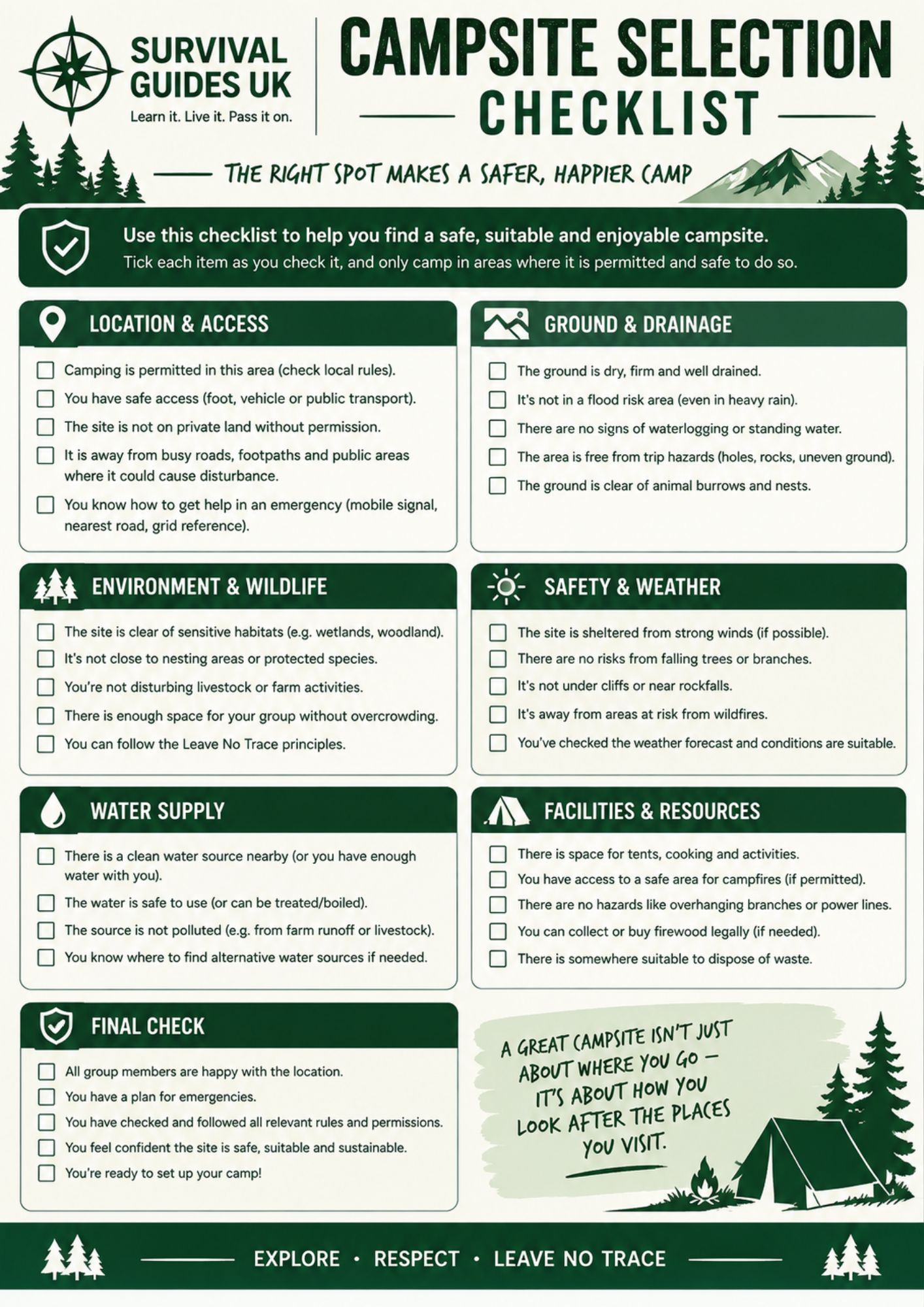
We’ve created this free printable Campsite Selection Checklist to give you a simple reference to use before setting up camp.
Download the free Campsite Selection Checklist
Restricted Content
Members Only
Join Survival Guides UK for free to access and download this resource.
JOIN FREE →The A4 printable is designed for Scouts, campers, hikers, outdoor groups and anyone learning practical camping skills.
Print it and keep it with your camping equipment, campcraft notes or outdoor skills folder.
For the best results, print at 100% scale on A4 paper.
What makes a good campsite?
A suitable campsite should be:
- Safe
- Legal
- Stable
- Well drained
- Appropriately sheltered
- Away from obvious hazards
- Suitable for the size of your group
- Accessible in an emergency
- Appropriate for the weather conditions
- Respectful of the surrounding environment
Don’t choose a campsite simply because it looks like a good place to pitch a tent.
Take a few minutes to stop, look around and assess the area first.
1. Check that camping is allowed
Before worrying about where to pitch your tent, make sure you are actually allowed to camp there.
Rules about camping vary throughout the UK and can depend on the landowner, campsite, local authority and location.
Check:
- Whether camping is permitted
- Whether permission from the landowner is required
- Local restrictions
- Campsite rules
- Any seasonal restrictions
- Fire or BBQ restrictions
If you’re using an established campsite, follow its rules and designated camping areas.
If you’re planning a wild camp, research the access and camping rights for the area before setting out.
2. Look at the ground
The ground beneath your tent can make a huge difference to your night’s sleep — and to your safety.
Look for ground that is:
Firm, reasonably level and well drained.
Avoid:
- Waterlogged ground
- Areas where water naturally collects
- Deep hollows
- Loose or unstable ground
- Large rocks
- Hidden holes
- Animal burrows
- Areas with obvious erosion
A site that looks perfectly dry in good weather could become very different after heavy rain.
Think about where water would flow if it started raining.
3. Consider flooding and drainage
Don’t pitch your tent in a depression simply because it appears flat.
Water naturally collects in low areas, and heavy rain can quickly turn a comfortable campsite into a wet one.
Before pitching, ask yourself:
“If it rained heavily tonight, where would the water go?”
Avoid:
- Dry riverbeds
- Stream channels
- Low-lying hollows
- Areas immediately beside watercourses
- Ground showing signs of recent flooding
Always take current weather conditions and local flood information into account.
4. Check above you
Looking down at the ground isn’t enough.
Look up as well.
Check for:
- Dead branches
- Damaged trees
- Unstable trees
- Rockfall hazards
- Cliffs
- Overhanging vegetation
- Power lines
- Other structures that could pose a hazard
Trees can provide useful shelter, but camping beneath damaged or dead branches can create a serious hazard, particularly during strong winds.
If you’re unsure about a location, choose another one.
5. Think about the weather
A campsite that is comfortable in calm weather may be unsuitable when conditions change.
Before choosing your site, consider:
- Wind direction
- Wind strength
- Rain
- Temperature
- Forecast thunderstorms
- Snow or ice
- Exposure
- Available shelter
Don’t rely solely on what the weather looks like when you arrive.
Check the forecast before your trip and continue monitoring conditions while you’re out.
If severe weather is expected, reconsider whether the planned campsite is appropriate.
6. Consider wind exposure
Wind is particularly important when camping.
An exposed campsite may become uncomfortable and potentially hazardous during strong winds.
Where appropriate, look for natural shelter while avoiding hazards such as:
- Dead trees
- Unstable branches
- Cliffs
- Rockfall areas
Remember that a sheltered location can also affect ventilation and smoke from cooking or fires.
7. Think about water
Water is an essential camping resource, but a nearby water source doesn’t automatically mean the water is safe to drink.
Consider:
- How much water you already have
- Whether a reliable water source is available
- Whether you are permitted to access it
- Whether the water needs treatment
- Potential contamination from livestock, agriculture or other sources
Never assume clear-looking water is safe to drink.
Follow appropriate water-treatment guidance for the area and your circumstances.
8. Look for wildlife and livestock
Your campsite is also part of someone else’s environment.
Before setting up, look for signs of:
- Animal burrows
- Nests
- Livestock
- Wildlife activity
- Insects
- Sensitive habitats
Avoid disturbing animals and don’t block their access to water, paths or feeding areas.
If camping near farmland, keep well away from livestock and follow local access guidance.
9. Consider access and emergencies
A remote campsite can be great, but you should still know how you would get help if something went wrong.
Before settling in, consider:
- How you would reach the nearest road
- Where the nearest access point is
- Whether you have mobile signal
- Where the nearest suitable meeting point is
- Your exact location
- A useful map reference or grid reference
For organised groups, everyone responsible for the activity should know the emergency plan.
10. Think about your group’s needs
The best campsite for one person might not be suitable for a large group.
Consider whether you have enough room for:
- Tents
- Cooking areas
- Activities
- Equipment
- Safe walkways
- Emergency access
Avoid overcrowding tents and equipment into a small area.
Leave enough space to move around safely.
11. Campfires and cooking
If you’re planning to have a campfire, BBQ or cooking area, check that fires are permitted first.
Choose a suitable location well away from tents and other flammable materials, and follow the rules of the campsite or landowner.
Never assume that camping somewhere means you can light a fire there.
For more information, see our Campfire Safety Guide.
12. Respect the environment
A good campsite should leave as little impact as possible.
Follow Leave No Trace principles where appropriate.
That means:
- Take your rubbish home
- Avoid damaging vegetation
- Don’t disturb wildlife
- Use established facilities where available
- Avoid sensitive habitats
- Follow local access rules
- Leave the area as you found it
A successful camping trip shouldn’t leave obvious evidence that you were there.
The final campsite check
Before pitching your tent, stop for one final assessment.
Ask:
Is it legal?
Can I camp here?
Is it safe?
Are there obvious hazards?
Is the ground suitable?
Will it remain suitable if the weather changes?
Is it sheltered?
Will wind and rain create problems?
Is there a water plan?
Do I have enough safe drinking water?
Can I get help?
Do I know exactly where I am and how I would raise the alarm?
Am I protecting the environment?
Will my campsite cause unnecessary damage or disturbance?
If you’re happy with all of these, you’ve made a much more informed campsite choice.
Campsite Selection Checklist
Use the printable guide to check:
☐ Camping is permitted
☐ Access is safe and appropriate
☐ Ground is firm and well drained
☐ There is no obvious flood risk
☐ There are no dangerous trip hazards
☐ No unstable trees or branches are overhead
☐ Weather conditions are suitable
☐ The site isn’t excessively exposed
☐ Wildlife and livestock won’t be disturbed
☐ You have a safe water plan
☐ There is enough room for your group
☐ Emergency access has been considered
☐ Any fire restrictions have been checked
☐ You can follow Leave No Trace principles
Download the printable checklist
Our Campsite Selection Checklist is designed as a quick reference for:
- Scouts and Guides
- Scout leaders
- Hikers and campers
- Duke of Edinburgh’s Award participants
- Outdoor education groups
- Wild campers
- Bushcraft enthusiasts
- Families learning camping skills
Take a few minutes to assess your campsite before you pitch. Choosing the right location can make your trip safer, more comfortable and more enjoyable.
Learn it. Live it. Pass it on.
Safety note
This is an independent educational resource from Survival Guides UK. It does not replace local regulations, landowner instructions, campsite rules, weather warnings or professional outdoor-safety advice. Always check the rules and conditions that apply to the specific area you’re visiting.
🔒Ready to test your survival skills?
Join Survival Guides UK for free, complete challenges, earn badges and increase your Survival Level.
JOIN FREE →
CRAIG BURR
FOUNDER · SURVIVAL GUIDES UK
I'm Craig, the person behind Survival Guides UK. I created SGUK because I wanted somewhere people could learn real outdoor skills in a practical, straightforward way — from lighting a fire and tying knots to navigation, campcraft and everything in between.
You can read more about the story behind SGUK here as well as our approach here.