10 Map Reading Games for Scouts: Fun Activities for Leaders
⚠️ SAFETY FIRST
Map reading activities can be run in a classroom, campsite or outdoors, but activities that involve moving around outside require appropriate planning and supervision.
Before sending teams out, check the map, terrain, weather, boundaries and hazards. Make sure Scouts know where they are allowed to go and have a clear instruction for what to do if they become unsure of their location.
Keep the challenge appropriate to the age and experience of the group. Accuracy and safe decision-making should always be more important than speed.
10 Map Reading Games for Scouts
Map reading is one of those skills that can initially seem complicated.
There are symbols to learn, grid references to understand, contour lines to interpret and scales to work out.
But Scouts don’t need to sit through a long lesson to learn these skills.
Turn map reading into a game and suddenly they’re looking at maps because they want to find the answer.
These 10 activities are designed for Scout leaders and can be adapted for different ages and abilities.
🧭 LEADER TIP
Don’t try to teach everything at once.
Start with map symbols and simple features, then gradually introduce grid references, scale, contours and route planning.
The objective is to build confidence with maps, not overwhelm beginners with information.
1. Map Symbol Bingo
Map symbols are one of the easiest places to start.
Create bingo cards containing different features that Scouts might find on a map.
For example:
- Road
- Footpath
- Woodland
- River
- Building
- Railway
- Bridge
- Campsite
- Church
- Contour line
Give each patrol a map.
Call out a feature.
The Scouts find its symbol and mark it on their card.
The first team to complete a line wins.
Make it harder
Instead of calling out the name, show them a map symbol.
They have to identify what it represents.
Skills developed
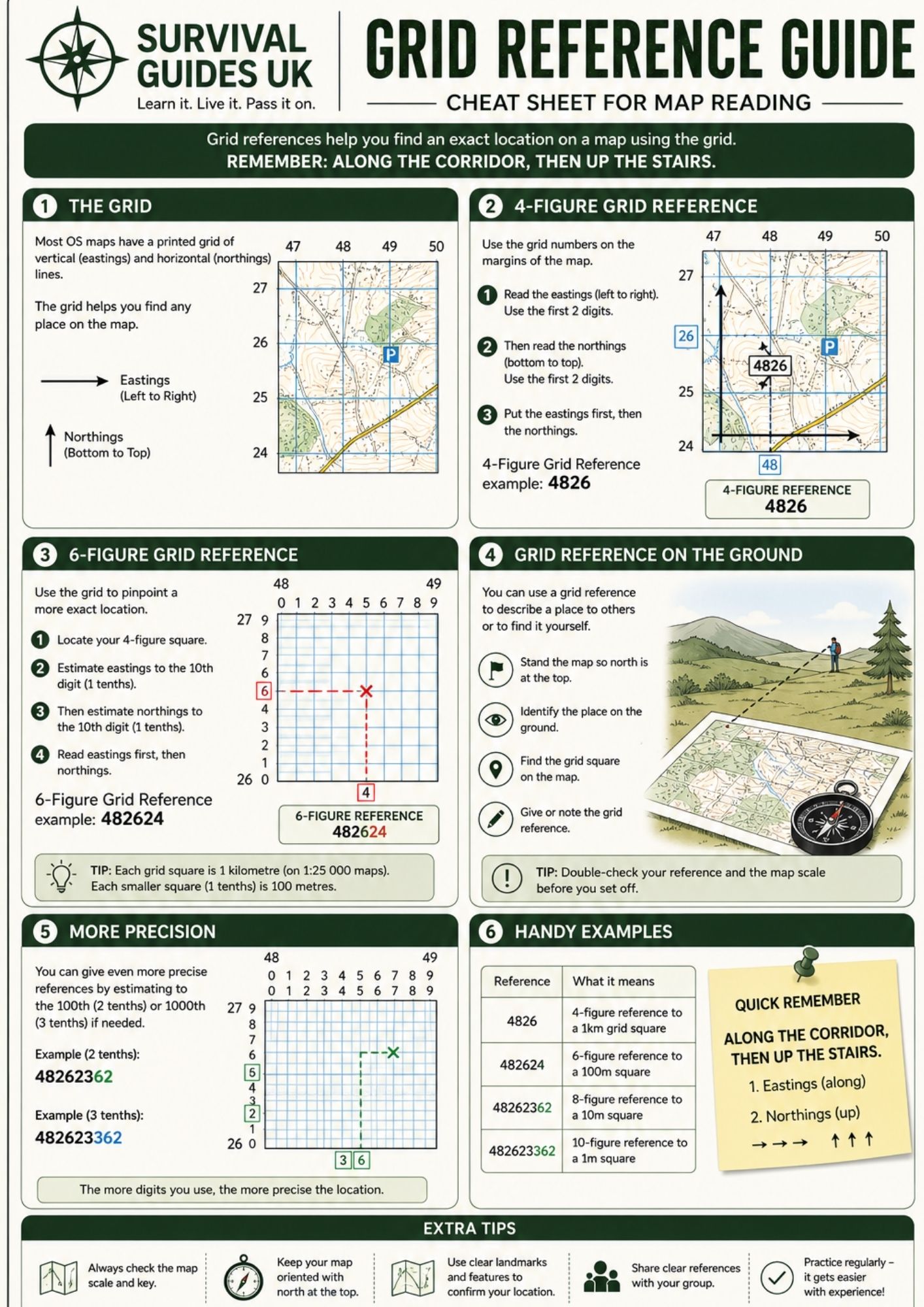
2. Grid Reference Treasure Hunt
Turn grid references into a treasure hunt.
Place numbered markers around a suitable area.
Give each team the grid reference for their first marker.
When they find it, they receive the next grid reference.
Eventually, all the locations lead to a final answer or prize.
Start with four-figure grid references.
Once Scouts are confident, introduce six-figure grid references.
Example
You might give them:
GR 1234
They use the map to find the location.
Later, introduce:
GR 123456
and explain how the additional numbers provide a more precise location.
Skills developed
3. Map Memory Challenge
Give each patrol a map.
Allow them a short amount of time to study it.
Then take the maps away.
Ask questions about what they saw.
For example:
Where was the river?
How many roads were near the campsite?
What was north of the woodland?
Where was the nearest bridge?
Teams write down their answers.
Return the maps and let them check.
Make it harder
Give them a blank piece of paper and ask them to draw a simplified version of the area from memory.
It doesn’t need to be geographically perfect.
The aim is to encourage them to notice important features and relationships.
Skills developed
4. What’s at the Grid Reference?
This is a simple but effective game.
Give Scouts a list of grid references.
They need to identify what is located at each one.
For example:
What is at GR 123456?
Possible answers might include:
- A road
- A building
- A stream
- Woodland
- A junction
- A hill
- A path
You can award points for correct answers.
Make it competitive
Give each patrol 10 grid references.
The team with the most correct answers wins.
Skills developed
5. Map Scale Challenge
Scale is an important part of map reading, but it can be difficult to understand in isolation.
Turn it into a practical challenge.
Give Scouts a map and several questions.
For example:
How far is it from the campsite to the bridge?
They measure the distance on the map and use the scale to estimate the real-world distance.
You can use:
- String
- Rulers
- Paper strips
- Map measuring tools
Make it a prediction game
Before measuring, ask each patrol to estimate the distance.
Then let them calculate it.
Award points for the closest estimate.
Skills developed
💡 LEADER TIP
Don’t worry if the first estimates are wildly inaccurate.
That’s part of the learning process.
Ask:
“Why did you think it was that distance?”
The discussion helps Scouts develop a better feel for map scale.
6. Spot the Difference
Give every patrol two maps or map extracts.
They look similar, but you’ve deliberately introduced a few differences.
For example:
- A road has disappeared
- A building has been added
- A path has changed
- A bridge is missing
- A woodland boundary is different
- A symbol has been replaced
Scouts have to identify as many differences as possible.
Alternative
Give them one map and a list of statements.
For example:
“There is a bridge north of the campsite.”
They must decide whether each statement is true or false.
Skills developed
7. Route Planning Challenge
Give each patrol a starting point and destination.
For example:
“Plan a route from the campsite to the village.”
Their task is to choose the route they think is best.
They should consider:
- Distance
- Paths
- Roads
- Rivers
- Bridges
- Terrain
- Steep slopes
- Other obstacles
Then each patrol presents its route.
The interesting part
There doesn’t have to be one correct answer.
Ask:
“Why did you choose this route?”
One patrol might choose the shortest route.
Another might choose a longer route using better paths.
Another might avoid steep terrain.
All three can provide useful discussion.
Skills developed
8. Contour Line Challenge
Contour lines can be one of the hardest map features for beginners to understand.
Make them physical.
Give Scouts several map extracts and ask:
Which hill is steepest?
Which hill is gentlest?
Where is the highest point?
Which route would involve the biggest climb?
Then, if you’re outdoors, visit a suitable area and ask Scouts to compare what they see with the contours on the map.
Simple rule
Contours close together = steeper ground.
Contours further apart = gentler ground.
Once Scouts understand that basic principle, the rest becomes much easier.
Skills developed
9. Map Puzzle
Turn a map into a puzzle.
Give each patrol a series of clues.
For example:
Find a church.
Find the road that runs south from it.
Follow the road until you reach a junction.
Identify the grid reference of the junction.
Find the nearest footpath.
Identify the feature at its end.
Each answer leads to the next clue.
You can eventually make the clues form a final message.
Why it works
The Scouts aren’t simply being asked:
“Can you read a map?”
They’re solving a problem using map information.
Skills developed
10. Design Your Own Map
For the final activity, turn Scouts into map makers.
Give each patrol a blank piece of paper.
Ask them to create a map of a fictional area.
They could include:
- Roads
- Paths
- Rivers
- Buildings
- Woodland
- Bridges
- Hills
- Campsites
- Points of interest
Give them a list of required features.
For example:
Include two roads.
Include a river.
Include a bridge.
Include woodland.
Include a hill.
Include a campsite.
They then swap maps with another patrol.
The second patrol has to interpret the map and answer questions about it.
Skills developed
🧠 WHY THIS WORKS
Creating a map forces Scouts to think about how information is represented.
If they can design a map that another person can understand, they’re already developing a much deeper understanding of map reading.
Bonus Game: Human Map
This needs almost no equipment.
Use an open, safe area and designate different parts of it as map features.
For example:
One Scout = church
One Scout = bridge
One Scout = woodland
One Scout = campsite
Arrange them according to a simple map.
The leader then calls out:
“Where is the bridge?”
or:
“What is north of the campsite?”
Scouts have to work out the relationships between the features.
This is particularly useful for younger sections who are just beginning to understand maps.
How to Progress Map Reading Skills
You can build these games into a natural progression.
Stage 1 — Map Symbols
What does this symbol mean?
↓
Stage 2 — Map Features
What is located here?
↓
Stage 3 — Grid References
Where is it?
↓
Stage 4 — Scale
How far away is it?
↓
Stage 5 — Contours
What is the terrain like?
↓
Stage 6 — Route Planning
Which way should we go?
↓
Stage 7 — Map to Ground
Can you match the map to what you see?
↓
Stage 8 — Independent Navigation
Can you use all of these skills together?
This progression works particularly well because each stage builds on the previous one.
Map Reading Games for Different Sections
Beavers
Keep it simple and visual.
Try:
- Human maps
- Map symbol games
- Simple treasure hunts
- Matching pictures to map features
The focus should be on exploration and curiosity.
Cubs
Introduce:
- Map symbols
- Simple grid references
- Basic scale
- Simple routes
- Map treasure hunts
Scouts
You can introduce:
- Six-figure grid references
- Scale calculations
- Contours
- Route planning
- Map-to-ground navigation
Explorers
Challenge them to:
- Plan routes independently
- Compare different routes
- Navigate unfamiliar areas
- Teach map skills to younger sections
- Combine maps with compass bearings
Always adjust the difficulty to the individual’s experience.
Turn Map Reading Into a Team Challenge
Patrols can work particularly well for map games.
Give each person a role.
For example:
Navigator — handles the map.
Compass operator — checks direction.
Recorder — writes down answers.
Observer — looks for features on the ground.
Timekeeper — monitors the activity.
Then rotate the roles.
This prevents one confident Scout from doing all the navigation.
🧭 LEADER TIP
Don’t let the strongest navigator become the permanent map holder.
Rotate responsibilities so everyone gets hands-on experience.
Accuracy vs Speed
Many map games naturally become races.
That’s fine, but consider what you’re rewarding.
If Scouts know that the fastest team always wins, they may rush their map work.
Instead, consider scoring:
|
Skill |
Example Points |
|---|---|
|
Correct answers |
5 |
|
Accurate grid references |
5 |
|
Good route choice |
5 |
|
Teamwork |
3 |
|
Safe decision-making |
3 |
|
Speed |
2 |
This makes the game about good navigation rather than simply running.
Common Map Reading Problems
“I don’t know what this symbol means.”
Use a map legend.
Encourage Scouts to look it up rather than simply asking the leader.
“I can’t find the grid reference.”
Remind them to work systematically across the map.
“The distance doesn’t look right.”
Check the map scale.
“The hill doesn’t look steep.”
Look at the spacing of the contour lines.
“The map doesn’t match what I can see.”
Stop and reassess.
The map may be misunderstood, or the group may not be where they think they are.
Map Reading Game Leader Checklist
Before running an outdoor activity:
Final Thoughts
Map reading doesn’t need to be complicated.
At its heart, you’re teaching Scouts to answer a series of simple questions:
What am I looking at?
Where am I?
What’s around me?
How far away is it?
What is the ground like?
Where should I go?
Games provide an excellent way to practise those questions without turning every session into a lesson.
The more comfortable Scouts become with maps in a fun environment, the more confident they’ll be when they eventually need to use those skills on a real walk or expedition.
🗺️ THE BIG IDEA
A map is a way of representing the real world.
Good map reading means learning to connect the symbols, lines, numbers and contours on the page with the roads, paths, hills, rivers and landmarks around you.
The best map reading games are the ones that help Scouts make that connection.
🔒Ready to test your survival skills?
Join Survival Guides UK for free, complete challenges, earn badges and increase your Survival Level.
JOIN FREE →
CRAIG BURR
FOUNDER · SURVIVAL GUIDES UK
I'm Craig, the person behind Survival Guides UK. I created SGUK because I wanted somewhere people could learn real outdoor skills in a practical, straightforward way — from lighting a fire and tying knots to navigation, campcraft and everything in between.
You can read more about the story behind SGUK here as well as our approach here.