10 Fire Safety Games for Scouts: Fun Activities for Leaders
⚠️ SAFETY FIRST
These games are designed to teach fire safety without putting Scouts in unnecessary danger.
Many of the activities below can be completed without a lit fire. Where a real fire is involved, it should only be used when permitted, properly planned, appropriately supervised and in accordance with your organisation’s current safety guidance and the rules of the site.
Scouts should never be encouraged to experiment with flames, fuels or accelerants. Never make fire safety into a competition where speed or risk-taking is rewarded.
The safest fire is often the one you don’t need to light.
10 Fire Safety Games for Scouts
Fire can be an incredibly useful outdoor skill.
It can provide warmth, allow food to be cooked and become an important part of camping and outdoor activities.
But fire also needs to be treated with respect.
For Scouts, learning fire safety shouldn’t just mean being told:
“Don’t touch the fire.”
Games and challenges can help young people understand why particular rules exist and what they should do if something goes wrong.
These 10 activities are designed primarily around fire safety and decision-making, rather than fire-lighting skills.
🔥 LEADER TIP
Teach the safety rules before introducing any practical fire activity.
Scouts should understand where they can stand, what they can touch, what they should never do and what the emergency procedure is before a fire is lit.
1. Spot the Fire Hazards
This is one of the easiest games to organise and requires no real fire.
Create a fictional campsite scene using pictures, cards or simple objects.
Include a mixture of safe and unsafe situations.
For example:
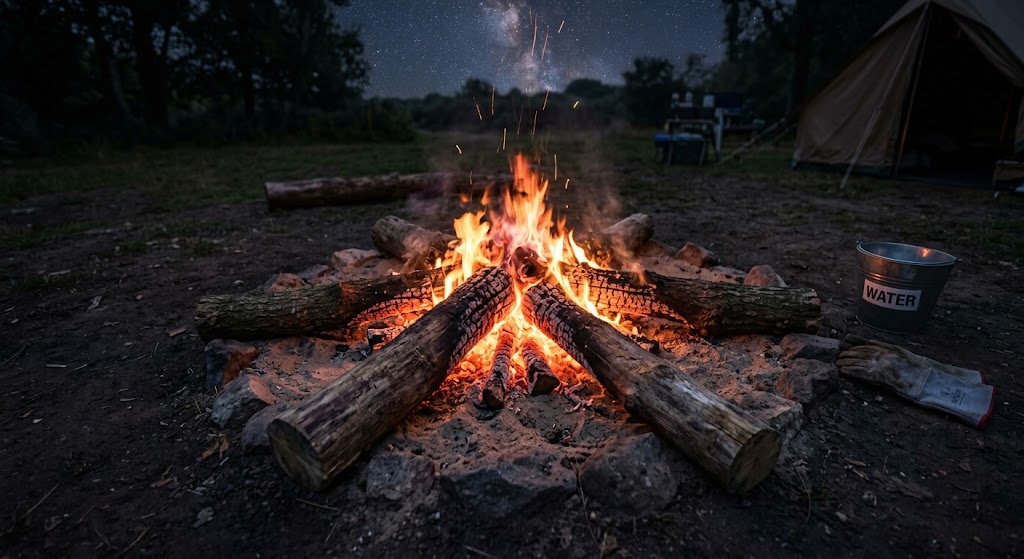
- Fire too close to a tent
- Loose clothing near flames
- Water or suitable extinguishing equipment nearby
- Fire unattended
- Fire built beneath overhanging branches
- Fire area clearly marked
- Flammable materials scattered around
- Someone carrying water towards the fire
- Wood stored too close to the flames
Give patrols a few minutes to identify as many hazards as possible.
Scoring
Award points for each correctly identified hazard.
Give bonus points if the Scouts can explain:
“Why is this dangerous?”
and:
“What would you do differently?”
Skills developed
2. Safe or Unsafe?
Prepare cards containing different fire-related situations.
For example:
“Someone leaves a campfire unattended.”
“Firewood is kept away from the fire area.”
“A Scout walks around the fire carrying a long stick.”
“The fire is completely extinguished before the group leaves.”
“Someone throws an aerosol can onto a fire.”
Teams must place each card into:
SAFE
or
UNSAFE
Then discuss the answers.
Make it harder
Add a third category:
DEPENDS
This encourages Scouts to understand that some situations depend on the circumstances.
Skills developed
3. Fire Safety Bingo
Create bingo cards containing fire safety rules.
Possible squares include:
- Keep a safe distance
- Never leave a fire unattended
- Keep loose clothing away
- Have suitable extinguishing equipment available
- Keep the fire area clear
- Follow site rules
- Don’t play near the fire
- Extinguish the fire properly
- Check the fire is out
- Tell an adult if something goes wrong
Read out a scenario or description.
Scouts identify the appropriate rule on their card.
💡 LEADER TIP
Instead of simply reading out the rule, describe why it matters.
For example:
“A strong gust of wind is blowing towards some dry grass.”
Scouts need to identify the relevant safety consideration.
4. What Would You Do?
Give each patrol a fire-related scenario.
For example:
“A strong wind suddenly starts blowing towards the fire.”
Or:
“Someone notices that clothing has been left too close to the fire.”
Or:
“The fire has been put out, but you can still see smoke.”
The team has to explain what they would do.
Important
There doesn’t always need to be one “magic answer”.
The aim is to encourage Scouts to:
- Recognise the hazard.
- Stop unsafe activity.
- Tell the appropriate adult.
- Follow the group’s emergency procedure.
- Move away from danger where necessary.
Skills developed
5. Fire Safety Memory Game
Place a selection of fire safety equipment or pictures on a table.
For example:
- Bucket
- Water container
- Fire blanket
- Gloves
- Firewood
- Fire area marker
- First-aid kit
- Torch
- Emergency contact information
Give Scouts a short amount of time to study everything.
Cover the items.
Remove one.
Ask:
“What’s missing?”
You can then ask a second question:
“Why might this item be useful around a campfire?”
Skills developed
6. Build the Safe Fire Area
This activity can be completed without lighting a fire.
Give each patrol a selection of cards or objects representing a campsite.
They need to arrange them into a safe fire area.
For example, they might have:
- Fire area
- Seating
- Firewood
- Water
- Tents
- Trees
- Cooking equipment
- Bags
- Clothing
- First-aid kit
Ask them to decide where everything should go.
Then introduce a scenario:
“The wind has changed direction.”
What needs to be reconsidered?
Or:
“More people are arriving at the campsite.”
What needs to change?
Skills developed
7. Fire Lay Matching Game
This game focuses on understanding different fire lays without requiring Scouts to light one.
Prepare cards showing different fire lay diagrams.
Other cards describe their characteristics or potential uses.
Scouts have to match them.
For example:
Fire lay diagram → name → characteristics
You can discuss why someone might choose one arrangement rather than another.
This also provides a natural opportunity to explain that the safest fire lay depends on the purpose, location, conditions and rules of the activity.
Skills developed
8. Extinguish the Fire — Decision Challenge
Rather than actually extinguishing a fire, turn the process into a decision-making game.
Give each patrol a series of cards showing stages of an imaginary campfire.
For example:
Fire still burning
↓
Flames gone
↓
Glowing material remains
↓
Smoke still visible
↓
Area appears cool
The Scouts must decide when the fire can be considered safely extinguished and what checks should be made.
You can then ask:
“Would you leave yet?”
This teaches an important lesson:
A fire that no longer has visible flames isn’t necessarily completely out.
Skills developed
9. Fire Safety Relay — Without Running
A traditional relay isn’t appropriate around a real fire.
Instead, create a station-based relay away from any flames.
Each station contains a fire safety question or challenge.
For example:
Station 1
Identify three fire hazards.
Station 2
Put fire safety rules in the correct order.
Station 3
Match equipment to its purpose.
Station 4
Identify the safest location for a fire.
Station 5
Explain what to do if the fire becomes unsafe.
Teams collect points at each station.
The highest-scoring team wins.
Skills developed
10. Fire Safety Investigator
This is the most advanced activity in the list.
Create a fictional campsite incident.
For example:
“A campfire was left in an unsafe condition. Something went wrong, and the group needs to work out what happened.”
Give Scouts a series of clues.
For example:
- Firewood was stored too close.
- The wind had increased.
- The fire area wasn’t clearly marked.
- Someone had left clothing nearby.
- The fire wasn’t properly checked before the group left.
The patrol must identify the chain of safety failures.
Then ask:
“Which problem should have been dealt with first?”
and:
“How could the incident have been prevented?”
Skills developed
Bonus Game: Fire Safety True or False
This is a quick activity that can be used at the start of a session.
Read out a statement.
Scouts decide whether it is true or false.
Examples:
“A fire is safe because there are no flames.”
“Wind can change the safety of a fire.”
“A fire should be left unattended if it’s only small.”
“Loose clothing can present a fire hazard.”
“You should know how a fire will be extinguished before lighting it.”
After each answer, explain why.
This works particularly well as a five-minute refresher before a campfire activity.
Make Fire Safety Games About Decisions
The most useful fire safety games aren’t necessarily the ones where Scouts memorise rules.
Try giving them situations where they have to make a decision.
For example:
“The wind has increased. What changes?”
“Someone has placed their backpack close to the fire. What do you do?”
“The fire has been extinguished but is still warm. Can you leave?”
“A Scout notices a hazard but isn’t sure whether to say anything. What should they do?”
These questions encourage Scouts to develop fire awareness, rather than simply repeating instructions.
🧠 THE KEY LESSON
Fire safety isn’t just knowing a list of rules.
It’s being able to spot changing hazards and make sensible decisions.
Fire Games for Different Scout Sections
Beavers
Keep activities simple and visual.
Try:
- Safe or Unsafe?
- Fire Safety Bingo
- Spot the Fire Hazards
- Memory games
Focus on recognising that fire is hot, dangerous and requires adult supervision.
Cubs
Introduce:
- Fire safety scenarios
- Safe fire area planning
- Fire equipment matching
- Basic fire lay recognition
Scouts
You can introduce:
- More detailed hazard assessment
- Fire lay challenges
- Extinguishing decision exercises
- Scenario-based problem solving
Explorers
Older participants can take more responsibility for:
- Planning a safe fire area
- Identifying hazards
- Explaining safety procedures
- Designing fire safety games
- Teaching younger sections
Actual fire activities should still follow the appropriate organisational safety requirements and supervision.
Fire Safety Game: What Should Never Be a Competition?
Some things are better kept out of the competitive element.
Don’t award points for:
Instead, reward:
🔥 SAFETY OVER SPEED
If a Scout wins a fire safety game by taking a risk, the game has taught the wrong lesson.
Make safe decisions the thing that earns the most points.
Fire Safety Leader Checklist
Before running any fire-related activity:
Why Fire Safety Games Work
Fire safety is partly about knowledge.
But it’s also about habits.
If Scouts regularly practise asking:
“What’s the hazard?”
“What could change?”
“What would I do?”
they are more likely to notice problems in a real outdoor situation.
Games also give leaders an opportunity to spot gaps in understanding.
A Scout might know that a fire needs to be extinguished, for example, but not understand that embers and hot material can remain dangerous after the flames have disappeared.
A simple game can reveal that misunderstanding before it becomes a problem.
Final Thoughts
Fire can be one of the most enjoyable parts of outdoor Scouting, but it needs to be approached with respect.
The goal of fire safety activities isn’t to make Scouts frightened of fire.
It’s to help them understand it.
Where are the hazards?
How can we reduce them?
What changes if the weather changes?
What should we do if something goes wrong?
By turning those questions into games, leaders can make fire safety memorable, practical and engaging without needing to put young people in unnecessary danger.
🔥 THE BIG IDEA
The best fire safety skill is recognising a problem before it becomes an emergency.
Teach Scouts to stop, look, think and speak up whenever something around a fire doesn’t look right.
🔒Ready to test your survival skills?
Join Survival Guides UK for free, complete challenges, earn badges and increase your Survival Level.
JOIN FREE →
CRAIG BURR
FOUNDER · SURVIVAL GUIDES UK
I'm Craig, the person behind Survival Guides UK. I created SGUK because I wanted somewhere people could learn real outdoor skills in a practical, straightforward way — from lighting a fire and tying knots to navigation, campcraft and everything in between.
You can read more about the story behind SGUK here as well as our approach here.