SGUK Outdoor Skills Challenge 50: Learn How Fog and Mist Behave in Woodland
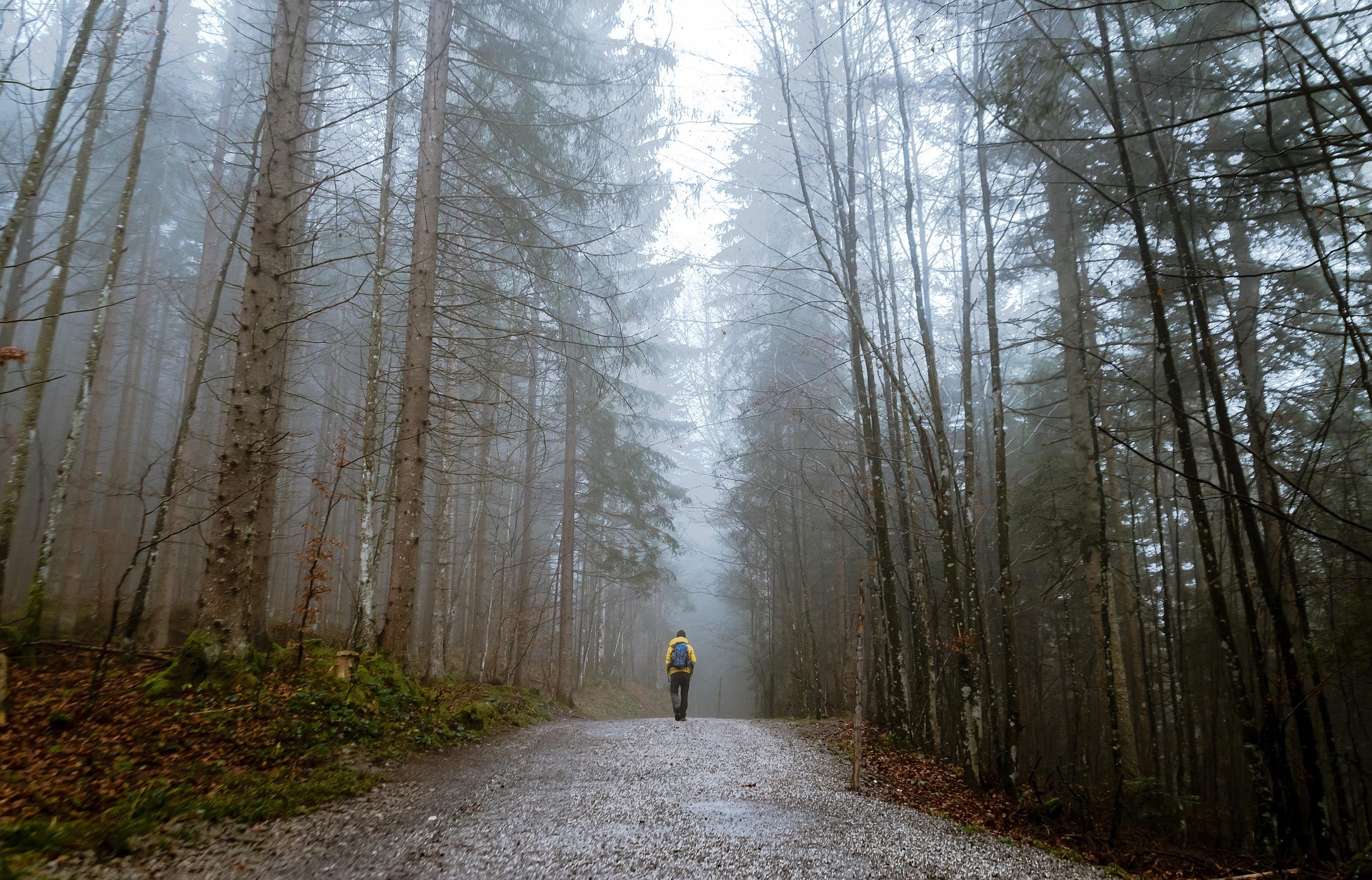
Fog and mist can change a familiar woodland surprisingly quickly. Paths that were easy to follow a few minutes earlier may become harder to recognise, distant landmarks can disappear, and it becomes more difficult to judge how far away things are. Even a woodland you know well can feel very different when visibility drops.
Understanding how fog and mist behave helps you recognise changing conditions and make sensible decisions before you lose confidence in your route. For this challenge, you will observe how reduced visibility affects your surroundings, learn why woodland can feel different in misty weather and practise deciding when it is sensible to continue or turn back.
Your Challenge
Your challenge is to learn how fog and mist affect woodland visibility and navigation, then demonstrate how you would respond if conditions changed during a walk.
You will observe the difference between nearby features and distant landmarks, identify potential navigation difficulties and explain how you would keep track of your position when you can no longer see as far ahead.
You do not need to venture into dense fog to complete this challenge. If conditions are clear, you can use a safe observation exercise and explain how you would apply the same skills when visibility deteriorates.
What You’ll Need
- Weather-appropriate outdoor clothing.
- A map of your local woodland or walking area.
- A compass, if you have one.
- A notebook or phone for recording observations.
- A camera or phone to photograph your evidence.
Choose a familiar, accessible location with clear paths and an easy way to return to safety. Check the forecast before leaving, and do not deliberately enter dense fog or unfamiliar woodland to complete the challenge.
Take the Challenge
1. Understand the difference between fog and mist
Fog and mist form when tiny water droplets remain suspended in the air and reduce visibility. They often develop when moist air cools, although local weather conditions and the landscape influence exactly where and when they appear.
The distinction is mainly based on how far you can see. In the UK, fog is generally used when visibility falls below 1,000 metres, while mist describes conditions where visibility is reduced but remains at least 1,000 metres.
In woodland, fog and mist may make tree trunks, path junctions and other familiar features less distinct. The effect can be particularly noticeable when looking between closely spaced trees, where the view is already restricted.
Your first task is to explain the difference between fog and mist in your own words and describe one way either could affect a woodland walk.
2. Observe how visibility changes with distance
Find a safe spot on a familiar path and look at several features at different distances. These might include a nearby tree trunk, a bend in the path, a signpost and a more distant group of trees.
Notice how clearly you can identify each feature. In misty conditions, nearby objects may remain easy to see while distant features become faint or disappear. If the weather is clear, use the same exercise to establish a baseline and explain what you would expect to change in fog.
Do not walk towards an uncertain feature just to find out what it is. The point is to recognise that reduced visibility makes it harder to identify landmarks and judge distance.
Record two examples of features that could become difficult to recognise in fog or mist.
3. Learn why woodland can feel different in fog
Trees, slopes, hollows and clearings can all influence the way you experience fog and mist. Cooler air may collect in low-lying areas, and damp conditions can leave vegetation and paths wet. However, fog does not always settle in hollows or remain below the treetops; wind, temperature and local terrain all affect its movement.
You may notice that a path seems to lead into a wall of grey, or that a clearing looks smaller because its edges are no longer visible. Familiar surroundings can become less recognisable when the visual details you normally use for orientation disappear.
Find a safe place where the woodland opens out or the path changes direction. Consider which landmarks would help you identify the location if distant views were obscured.
If the weather is clear, describe the landmarks you would use and explain why relying on one distant feature would be unwise.
4. Understand how fog affects navigation
When visibility is poor, it is easier to miss a path junction, walk past a turning or mistake one section of woodland for another. This is particularly important where several tracks look similar or paths cross open ground between trees.
Think about how you would navigate if you could see only a short distance ahead. You would need to pay closer attention to your map, route description, compass bearings where appropriate, and nearby features that you can identify confidently.
Avoid relying on memory alone, especially if the route contains several similar junctions. A compass can help you maintain a direction, but it does not tell you whether you are on the correct path or whether an obstacle lies ahead.
For this part of the challenge, choose a short route you know well and identify two points where you would need to check your position. Explain what information you would use at each point.
5. Practise making a safe decision
Fog does not automatically mean every walk must stop, but worsening visibility can make a route unsuitable for your experience, equipment or the conditions.
Before setting out, consider the forecast, the terrain, the length of the walk and whether you have the skills to navigate if landmarks disappear. If fog develops while you are walking, pause somewhere safe and reassess rather than continuing simply because you planned to finish the route.
If you can confidently identify your location and follow a safe route back, returning may be the sensible option. If you are unsure where you are, avoid wandering in search of a familiar landmark. Stop, check your map and compass if you can use them confidently, and contact emergency services if you are lost and cannot safely recover your position or face immediate danger.
Your task is to describe what you would do if fog became noticeably thicker halfway through a woodland walk. Include how you would check your position and decide whether to continue, retrace your steps or seek help.
6. Record what you have learned
Finish by summarising the main lessons from your observations. Include the difference between fog and mist, two ways reduced visibility could affect navigation and one action you would take if conditions deteriorated.
If you observed actual fog or mist, you can include a photograph showing the conditions from a safe path. If the weather was clear, photograph a suitable landmark or your map and use your written explanation to demonstrate how you would apply the skills.
The aim is to show that you understand how reduced visibility changes the decisions you make outdoors, not to prove that you can walk safely in every type of fog.
Check Your Results
Before completing the challenge, make sure you can answer these questions:
- What is the difference between fog and mist?
- Why can a familiar woodland become harder to navigate when visibility drops?
- Why is it risky to rely on distant landmarks or memory alone?
- How can a map and compass help, and what can they not tell you?
- What would you do if fog thickened and you became uncertain of your position?
If you cannot answer one of these confidently, revisit that part of the challenge and try explaining it in your own words.
Complete the Challenge
To complete Challenge 50, demonstrate that you understand how fog and mist affect woodland conditions and how you would respond to reduced visibility.
Your evidence should include:
- An explanation of the difference between fog and mist.
- Two examples of how reduced visibility could affect your ability to recognise landmarks or follow a route.
- A photograph of your observation location, suitable landmarks or navigation preparation.
- A short description of what you would do if fog became thicker during a walk.
You can complete the observation in clear weather. You should never put yourself at risk or deliberately enter dense fog simply to obtain photographic evidence.
How to Submit Your Challenge
Submit your evidence
Once you have completed the challenge, share your evidence on your SGUK member profile so it can be checked.
- Go to your SGUK member profile.
- Open Social Activity.
- Upload a photograph of your evidence to the activity wall.
- Add the hashtag #SGUKChallenge50.
- Share it for verification.
Include your explanations with your photograph so it is clear what you observed and how you would apply your knowledge on a real woodland walk.
Challenge 50 Checklist
Want to Push Yourself?
Choose a familiar woodland route and study its map before your next visit. Identify several junctions, bends or other features that would help you confirm your position if distant landmarks were hidden.
Write a simple navigation plan that explains where you would check the map, which features you would look for and what you would do if the route no longer matched your expectations.
You could also compare the same location on a clear day and a misty day, provided the conditions remain safe. Notice which details disappear first and how that changes your confidence in identifying the route.
The aim is to build the habit of noticing changing conditions early and adapting your plans before a manageable walk becomes a difficult situation.
What’s Next?
If you have not completed the previous challenge, try SGUK Outdoor Skills Challenge 49: Practise Staying Warm in Woodland. Learn how clothing layers, wind protection and ground insulation help you stay comfortable outdoors.
You can complete SGUK Outdoor Skills Challenges in any order, so choose the skills that interest you and keep building your practical outdoor knowledge.
Once you’ve shared your evidence and it has been verified, the SGUK Outdoor Skills Challenge 50 is complete and the completed challenges figure will be updated on your profile.
Learn. Practise. Master.
That’s what the SGUK Outdoor Skills Challenge is all about.
🔒Ready to test your survival skills?
Join Survival Guides UK for free, complete challenges, earn badges and increase your Survival Level.
JOIN FREE →
CRAIG BURR
FOUNDER · SURVIVAL GUIDES UK
I'm Craig, the person behind Survival Guides UK. I created SGUK because I wanted somewhere people could learn real outdoor skills in a practical, straightforward way — from lighting a fire and tying knots to navigation, campcraft and everything in between.
You can read more about the story behind SGUK here as well as our approach here.