Calorie Planning: Scout Camping and Expedition Guide
Activity Overview
Difficulty: Moderate
Time: 30–45 minutes
Location: Campsites, expedition bases and suitable outdoor planning areas
Best for: Scouts, Explorers, Patrol Leaders and adult leaders
Skills: Meal planning, nutrition, estimation, expedition planning and food management
Calorie planning means making sure your food provides enough energy for the activity without unnecessarily increasing the weight you have to carry.
For Scouts, avoid using a single calorie target for everyone. Energy needs vary with age, body size, activity level, weather and individual circumstances.
The aim is to provide regular, balanced meals and snacks rather than encouraging Scouts to count calories rigidly.
What You’ll Learn
You’ll learn how to estimate the energy demands of an outdoor activity and use that information when planning meals.
You’ll also learn how to choose foods that provide useful energy, spread food throughout the day and adjust plans for particularly demanding activities.
🟡 SAFETY – MODERATE RISK
Food and energy planning should support participation rather than weight loss or restrictive eating.
Children and teenagers have different nutritional needs from adults, and requirements vary considerably between individuals.
Don’t encourage Scouts to compete over how few calories they can consume or use calorie restriction as part of an outdoor challenge.
Take allergies, intolerances, medical dietary requirements and cultural or religious requirements into account.
Anyone with specific nutritional or medical needs should have those requirements considered with appropriate professional advice.
Equipment
You’ll need a meal plan and shopping list.
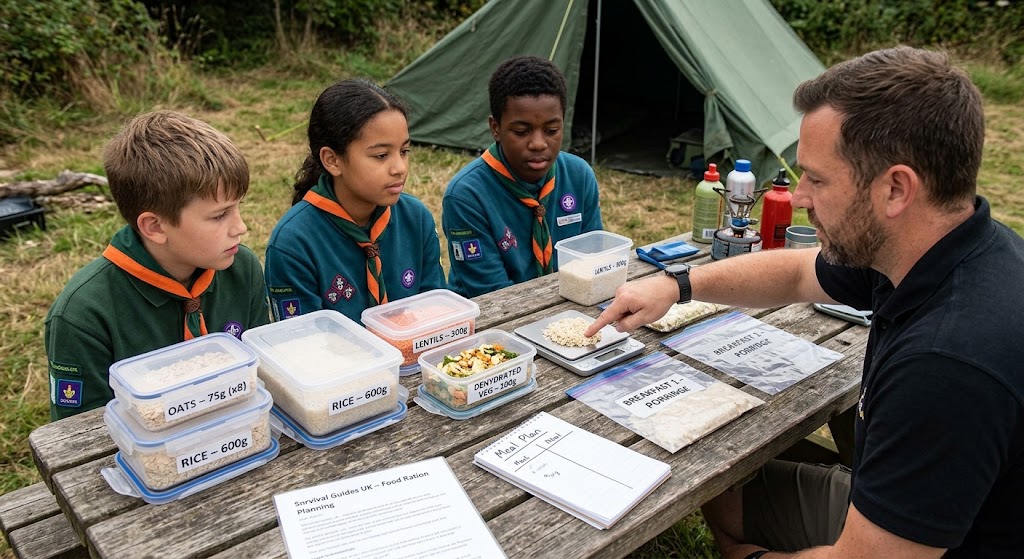
Kitchen scales can help estimate ingredient quantities.
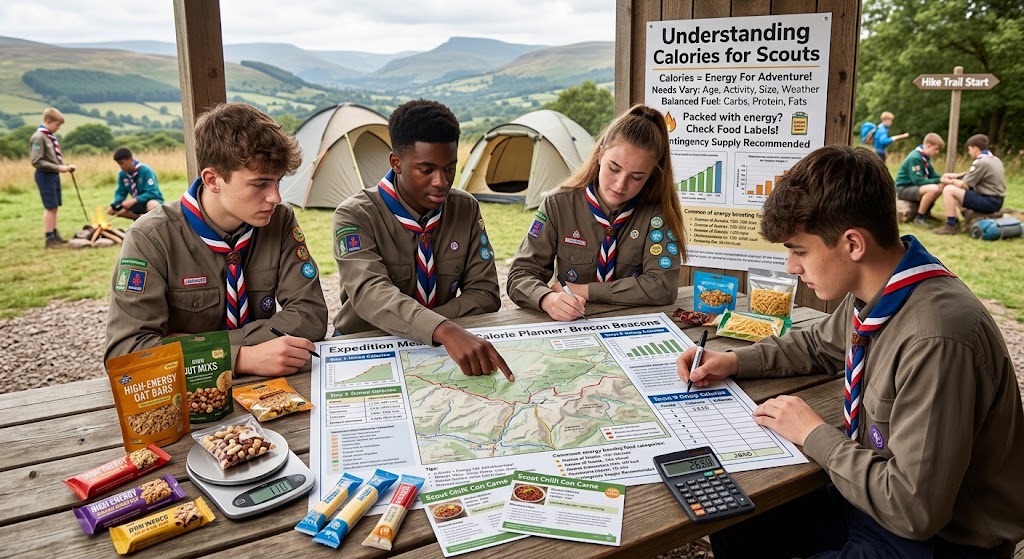
Food labels can provide energy information when planning packaged foods.
A calculator or simple spreadsheet can make larger group calculations easier.
For backpacking, a kitchen scale can also help compare the weight of different food options.
Prerequisites
Before planning calories, establish:
Instructions
1. Start With the Activity
Think about what the Scouts will actually be doing.
A relaxed campsite weekend requires different amounts of energy from a full day of hiking, pioneering or other physically demanding activities.
Don’t calculate food requirements without considering the activity.
2. Consider the Group
Avoid assuming everyone needs the same amount.
Age, body size, activity level and individual appetite all affect energy requirements.
For a mixed-age Scout group, it is usually more practical to provide sufficient balanced food and allow individuals to eat appropriate portions than to assign everyone an identical calorie allowance.
3. Plan Regular Meals
Start with the main meals.
Breakfast, lunch and dinner should provide useful sources of energy and a mixture of nutrients.
Meals containing carbohydrates are particularly useful for supporting physical activity.
Include protein, fruit and vegetables where practical.
4. Add Snacks
Snacks can help maintain energy during long or active days.
Suitable options might include dried fruit, oat bars, sandwiches, nuts where appropriate, or other foods that travel and store well.
For activities involving allergies, check ingredients carefully.
5. Consider Energy Density
For backpacking, food weight matters.
Some foods provide considerable energy without taking up much space or adding excessive weight.
However, don’t select food purely because it has the highest calorie content.
Nutrition, taste, storage, preparation and suitability for the group all matter.
6. Use Food Labels
Packaged foods usually provide energy information on the label.
Energy may be shown in kilojoules (kJ) and kilocalories (kcal).
If comparing foods, make sure you’re comparing the same serving size.
For example, a product might list energy per 100 g while another lists energy per portion.
7. Calculate Group Requirements
Once you have a sensible estimate for an individual meal, multiply it by the number of people.
For example, if a planned meal provides approximately 600 kcal per person for 8 people:
600 × 8 = 4,800 kcal
This gives an estimate for the group meal, not a recommendation that every person must consume exactly that amount.
8. Plan for Active Days
On a particularly active day, Scouts may naturally want more food.
Have additional suitable snacks available rather than trying to keep everyone to a fixed daily total.
A group hiking several miles is likely to need more readily available food than a group spending the day around camp.
9. Consider the Weather
Cold weather can make outdoor activities more demanding and can affect appetite and food preparation.
Hot weather creates additional hydration considerations.
Don’t treat calories as the only nutritional consideration.
Ensure adequate drinking water and appropriate hydration arrangements are part of the overall plan.
10. Spread Energy Through the Day
Avoid planning almost all the day’s food for one large evening meal.
Breakfast, lunch and snacks should provide energy throughout the day.
This is particularly important when Scouts are walking or undertaking other sustained activity.
11. Plan Easy-to-Eat Food
Food should be practical for the activity.
If Scouts need to eat while walking, choose something that can be safely carried and eaten without lengthy preparation.
Save meals requiring cooking and preparation for appropriate breaks or camp.
12. Consider Cooking Fuel and Time
A theoretically efficient food isn’t necessarily useful if it takes excessive fuel or time to prepare.
For expeditions, consider the complete system: food weight, cooking time, fuel, water and equipment.
13. Include a Contingency
Long outdoor activities can overrun.
Carry a sensible reserve of suitable food for unexpected delays.
The amount required depends on the length, location and remoteness of the activity.
14. Monitor the Group
During a demanding activity, watch for signs that someone may need a break, food or water.
Don’t rely on a calorie calculation to determine how an individual should feel or what they should eat.
Encourage Scouts to communicate if they are hungry, tired, unwell or struggling.
Understanding Calories and Kilocalories
The term “calorie” is commonly used when discussing food energy, but food labels generally use kilocalories (kcal).
One kilocalorie is the amount of energy required to raise the temperature of one kilogram of water by approximately one degree Celsius.
Food energy may also be listed in kilojoules.
For practical camp planning, the important point is to compare values using the same unit and serving size.
Calorie Planning for Hiking
A hiking day can require considerably more energy than a day spent around camp.
Rather than giving every Scout a strict calorie target, plan regular meals and carry accessible snacks.
For longer hikes, consider when food breaks will happen and make sure everyone has enough accessible food for the route.
Calorie Planning for Camps
At a static campsite, food can be more varied because there is less need to carry everything.
This gives you more flexibility with fresh ingredients and cooked meals.
You can still use calorie information when planning quantities, but appetite and activity should guide how much individual Scouts actually eat.
Calorie Planning for Expeditions
Expeditions require more careful planning because food has to be carried.
Consider the energy provided by each food against its weight.
A useful calculation is:
Energy density = calories ÷ food weight
For example, if 100 g of a food provides 400 kcal, its energy density is 4 kcal per gram.
This can help compare different foods when pack weight is important.
Avoiding Unnecessary Calorie Counting
For young people, food planning should be about fuel, nutrition and enjoyment, not dieting.
Scouts should learn that food provides the energy needed for walking, learning, working and enjoying outdoor activities.
A good expedition plan makes nutritious food available and lets individuals respond to their own hunger and appetite.
Final Tip
Calorie planning for Scouts isn’t about giving everyone a precise number to hit.
It’s about making sure the group has enough nutritious food to support the activity, with suitable meals, snacks and contingency supplies.
For expeditions, consider energy density alongside weight and preparation. For everyone, remember that adequate food and hydration matter more than achieving a perfect calorie calculation.
🔒Ready to test your survival skills?
Join Survival Guides UK for free, complete challenges, earn badges and increase your Survival Level.
JOIN FREE →
CRAIG BURR
FOUNDER · SURVIVAL GUIDES UK
I'm Craig, the person behind Survival Guides UK. I created SGUK because I wanted somewhere people could learn real outdoor skills in a practical, straightforward way — from lighting a fire and tying knots to navigation, campcraft and everything in between.
You can read more about the story behind SGUK here as well as our approach here.