Beavers Progression: A Guide to Skills, Badges and Moving On to Beavers
⚠️ SAFETY & AGE-APPROPRIATENESS NOTE
Beavers are 6–8 years old, so activities should be appropriate for their age, abilities and individual needs.
Children should have suitable adult supervision for activities involving fire, cooking, water, tools, climbing, outdoor exploration and other potential hazards.
Progression isn’t about making activities unnecessarily difficult. It’s about helping young people become more confident, capable and independent while keeping activities safe and enjoyable.
What Is Beavers Progression?
Beavers are the second section of the Scouts programme, for young people aged 6 to 8.
For many children, Beavers is where they start to become more independent.
They may already have experience of Squirrels, or Beavers may be their first experience of Scouts.
Either way, the programme provides opportunities to:
- Try new activities
- Learn practical skills
- Make friends
- Work as a team
- Explore the outdoors
- Take responsibility
- Develop confidence
- Solve problems
- Discover new interests
The Scouts programme describes the journey as one of trying new things and steadily growing.
THE BIG IDEA
Progression isn’t simply about collecting badges.
It’s about what the young person can do, understand and experience as they move through Beavers.
How Does Beavers Progression Work?
There are several different parts of the Beaver programme.
These include:
- Membership Award
- Challenge Awards
- Activity Badges
- Staged Activity Badges
- Joining In Awards
- Moving On Award
- Leadership Stripes
- Chief Scout’s Bronze Award
- Other awards and opportunities within the wider Scouts programme
The key difference from Squirrels is that Beavers are beginning to take considerably more ownership of their activities.
Starting Beavers
The first stage is simply becoming comfortable.
A new Beaver may need time to:
- Meet their leaders
- Make friends
- Learn the Colony routine
- Understand the Promise
- Discover what Beavers do
- Get used to group activities
- Learn how to work within a Lodge
The Membership Award recognises this first step in their Scout journey.
For a child arriving from Squirrels, this may feel like a natural continuation.
For a new member, it can be a completely new adventure.
From Squirrels to Beavers
Some Beavers will have already developed a good range of Scout skills through Squirrels.
The transition provides an opportunity to build on them.
For example:
Squirrels: Follow a simple trail.
Beavers: Follow a route and explain what they discovered.
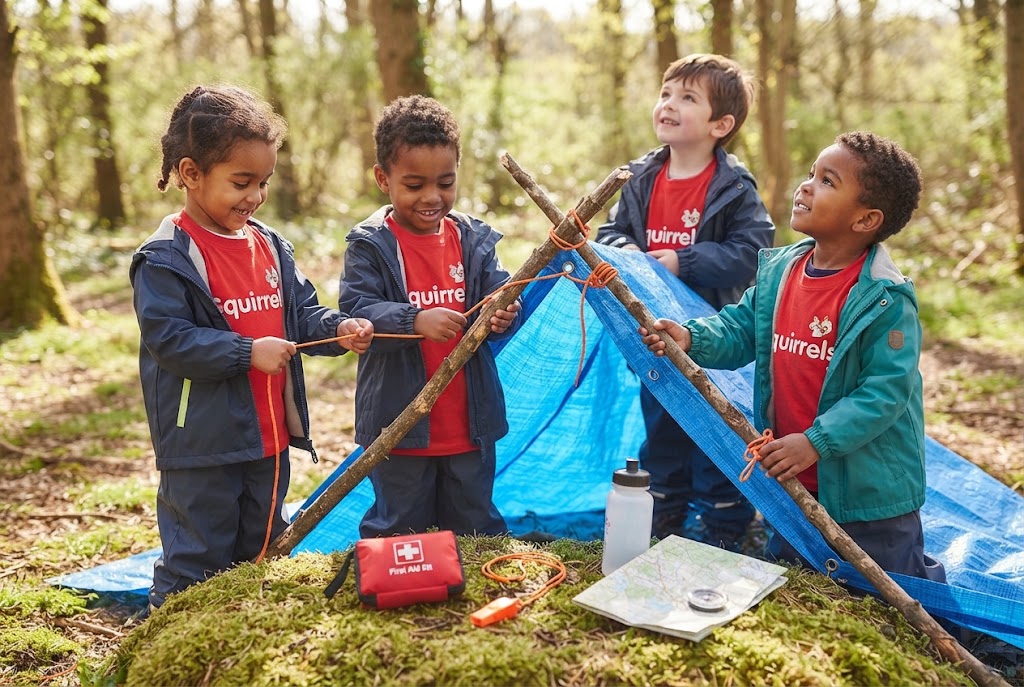
Squirrels: Build a simple den.
Beavers: Work together to plan and construct a larger den.
Squirrels: Learn basic safety.
Beavers: Begin taking more responsibility for identifying hazards.
Squirrels: Try a simple outdoor activity.
Beavers: Take part in a wider outdoor adventure.
The objective isn’t to make everything harder immediately.
It’s to gradually increase confidence and independence.
The Six Beaver Challenge Awards
The current Beaver programme has six Challenge Awards:
- My Adventure Challenge Award
- My Outdoors Challenge Award
- My Skills Challenge Award
- My World Challenge Award
- Personal Challenge Award
- Teamwork Challenge Award
All six are required for the Chief Scout’s Bronze Award.
These challenges cover a broad range of experiences, from outdoor adventure and practical skills to teamwork and personal development.
My Adventure Challenge Award
This award is about trying adventurous activities and getting outdoors.
The current requirements include trying two adventurous activities and taking part in six other outdoor activities. Examples include activities such as climbing, archery, swimming, following trails, building dens and obstacle courses.
This makes it a natural fit for outdoor-focused Beavers programmes.
Adventure doesn’t have to mean doing something extreme.
For a Beaver, adventure could simply mean:
ADVENTURE TIP
Adventure is about the experience, not how scary or difficult the activity is.
My Outdoors Challenge Award
This is particularly relevant to camping and outdoor skills.
The current requirements include taking part in a camp or sleepover and helping with activities such as putting up a tent, collecting wood, cooking, washing up or setting up a sleeping area.
It also includes:
This is a great example of how several SurvivalGuidesUK topics can naturally support Scout progression.
OUTDOOR SKILLS
Beavers don’t need to become expert campers.
The aim is to help them become comfortable, safe and confident outdoors.
My Skills Challenge Award
This award focuses on developing practical, creative and personal skills.
Requirements include:
The practical skills can include things such as:
These might seem like small things, but they are exactly the sort of skills that build independence.
My World Challenge Award
This award helps Beavers understand their local community and the wider world.
It can involve:
The aim is to help young people understand that they’re part of something bigger than their Colony.
Teamwork Challenge Award
Teamwork becomes increasingly important as children move through Scouts.
Beavers might need to:
Good teamwork isn’t simply about everyone doing the same thing.
It’s about learning how to work together towards a shared goal.
LEADER TIP
Give Beavers opportunities to solve problems without immediately providing the answer.
Ask:
“What do you think we should try?”
Personal Challenge Award
This is one of the most individual parts of the Beaver programme.
The Beaver completes two personal challenges, with one chosen by the Beaver and the other chosen by their leader. The challenges should be something the Beaver finds difficult but can achieve with effort and commitment.
This is important because every child is different.
One Beaver’s challenge might be:
“Try an activity I’m nervous about.”
Another might be:
“Remember to bring my scarf every week.”
Another could be:
“Help a new Beaver settle in.”
Progression therefore becomes personal.
Why Personal Challenges Matter
A child shouldn’t have to compete with another child to demonstrate progress.
The Personal Challenge Award recognises something much more meaningful:
“I found this difficult, but I kept working at it.”
That’s a valuable life skill.
It teaches:
Activity Badges
Alongside the Challenge Awards, Beavers can work towards Activity Badges.
These allow young people to explore individual interests.
Depending on the current programme, examples include areas such as:
- Animal care
- Creativity
- Cycling
- Experimenting
- Exploring
- Hobbies
- International activities
- Space
- Cooking
- Camp craft
Scouts also provides a range of Staged Activity Badges, which can continue through several Scout sections.
BADGE TIP
Activity Badges are a great opportunity to let Beavers discover what they’re interested in.
Not every Beaver needs to enjoy the same activities.
Staged Activity Badges
Staged Activity Badges are particularly useful for progression because the skill can continue developing as the young person gets older.
Current staged opportunities available to Beavers include areas such as:
- Air Activities
- Community Impact
- Digital Citizen
- Digital Maker
- Emergency Aid
- Hikes Away
- Musician
- Nautical Skills
- Navigator
- Nights Away
- Paddle Sports
- Sailing
- Snowsports
- Swimmer
- Time on the Water
These can provide a natural bridge between sections.
A Beaver might start developing a skill that they continue through Cubs and beyond.
The Chief Scout’s Bronze Award
The Chief Scout’s Bronze Award is the highest award a Beaver can earn.
To achieve it, a Beaver must complete:
All Six Challenge Awards
- My Adventure
- My Outdoors
- My Skills
- My World
- Teamwork
- Personal Challenge
Plus:
Four Activity or Staged Activity Badges
The four badges can be chosen by the Beaver.
This means there is a balance between:
Core experiences through the Challenge Awards
and
Personal interests through Activity Badges.
Bronze Award Progression
The Bronze Award shouldn’t be viewed as something that needs to be rushed.
A Beaver has their entire time in the section to work towards it.
They may complete some requirements quickly and take longer over others.
That’s perfectly normal.
🥉 BRONZE AWARD TIP
Think of the Chief Scout’s Bronze Award as a journey through Beavers, rather than a final exam at the end.
Scouts also states that if a Beaver hasn’t quite finished everything before moving to Cubs, they can complete the remaining elements during their first term as a Cub.
Outdoor Skills and Beavers Progression
Beavers can develop outdoor skills through:
- Navigation
- Camping
- Den building
- Knots
- Nature identification
- Weather awareness
- First aid
- Water safety
- Fire safety
- Cooking
- Outdoor clothing
- Survival awareness
These should always be taught at an appropriate level.
For example, fire safety for a Beaver should focus heavily on understanding hazards, safe behaviour and supervised participation rather than expecting a child to independently manage a fire.
Progression Through Camping
Camping is a particularly good example of gradual progression.
First Experience
A Beaver might attend a short sleepover.
Developing Confidence
They help prepare their sleeping area.
Next Step
They help put up a tent.
Developing Skills
They learn simple knots and help with camp tasks.
Greater Independence
They begin to understand what equipment they need and why.
The objective is not to make children completely self-sufficient.
It’s to gradually teach them how to look after themselves and contribute to the group.
Progression Through Navigation
Navigation can also develop gradually.
Beginner
Recognise basic map symbols.
Developing
Follow a simple trail.
Confident
Use a map to find specific locations.
More Independent
Work as a small team to navigate a short route.
This fits naturally with the Beaver Explore Activity Badge and the Navigator Staged Activity Badge.
Progression Through First Aid
Beavers can begin learning more than simply:
“Tell an adult.”
They can start developing an understanding of:
- What an emergency is
- How to stay safe
- How to get help
- What a first-aid kit is for
- How to deal with very minor injuries
- How to respond when someone else is hurt
- When to call 999
The Beaver programme’s My Outdoors Challenge Award includes basic accident awareness and simple first aid.
This makes first aid a particularly useful skill to revisit throughout the Beaver years.
Leadership in Beavers
Beavers are young, but they can still begin developing leadership skills.
Scouts currently recognises Leadership Stripes for peer leaders within a Lodge. These young people can take on additional responsibilities such as helping new Beavers settle in or helping run games.
Leadership doesn’t mean standing in front of everyone and giving orders.
For a Beaver, leadership might simply mean:
From Following Instructions to Making Decisions
This is one of the biggest differences between early Squirrels progression and Beavers progression.
A young child might initially need:
“Do this.”
As they develop, you can start asking:
“What do you think we should do?”
That shift encourages:
- Decision-making
- Problem-solving
- Confidence
- Responsibility
It doesn’t mean removing adult supervision.
It means giving children safe opportunities to make choices.
Don’t Make Progression a Competition
One Beaver might earn lots of Activity Badges.
Another might concentrate on Challenge Awards.
Another might struggle with a particular skill but make enormous progress personally.
They are all progressing.
The best question isn’t:
“Who has the most badges?”
It’s:
“What has this Beaver learned?”
Progression Through Confidence
A Beaver who was nervous about sleeping away from home may eventually manage a sleepover.
That’s progression.
A Beaver who wouldn’t speak in front of the Colony may eventually explain an activity.
That’s progression.
A Beaver who always needed help packing their equipment may eventually remember most of it themselves.
That’s progression.
The badge is the recognition.
The development is the achievement.
Preparing to Move to Cubs
Eventually, Beavers move on to Cubs.
Scouts says this generally happens between 7½ and 8½, and the Moving On Award helps Beavers get to know their new leaders, make new friends and experience what Cubs is like before moving up.
A good transition can include:
Moving on should feel like the next step in the adventure.
What Should a Beaver Be Able to Do Before Cubs?
There’s no single checklist of abilities that every child needs to master.
But a Beaver who has developed through the programme may have gained experience in:
Personal Skills
- Looking after their belongings
- Taking responsibility
- Trying new things
- Setting personal goals
Social Skills
- Working in a team
- Helping others
- Listening
- Communicating
Outdoor Skills
- Basic camping
- Simple knots
- Navigation
- Nature awareness
- Outdoor safety
Practical Skills
- Basic cooking
- Simple first aid
- Problem-solving
- Creative activities
Adventure
- Trying unfamiliar activities
- Exploring outdoors
- Taking part in camps or sleepovers
These foundations provide an excellent starting point for Cubs.
Beavers Progression Checklist
Confidence
Independence
Teamwork
Outdoor Skills
Personal Development
Leadership
Beavers Progression: The Bigger Picture
The Scout journey is a long one.
Squirrels → Beavers → Cubs → Scouts → Explorers → Network
Each section provides new opportunities and gradually increases the level of independence and responsibility.
But progression isn’t a straight line.
A child might be very confident outdoors but nervous about speaking to a group.
Another might be an excellent communicator but need more support with physical activities.
Another might be brilliant at problem-solving but reluctant to try something unfamiliar.
The programme gives them opportunities to develop all of these areas.
Final Thoughts
Beavers is an important stage in the Scout journey.
It’s where many young people begin moving from:
“Can you help me?”
towards:
“I’ll have a go.”
And eventually:
“I can help someone else.”
The six Challenge Awards provide a broad framework for development, while Activity and Staged Activity Badges allow Beavers to explore their own interests. The Chief Scout’s Bronze Award then brings much of that journey together.
But the most important measure of progression isn’t the number of badges sewn onto a uniform.
It’s the child underneath them.
More confident.
More capable.
More willing to try.
More prepared to help.
And ready for their next adventure.
THE BEAVERS PROGRESSION MOTTO
Try something new. Learn a skill. Help someone else. Keep going.
That’s what progression is really about.
Useful official resources
Scouts – Chief Scout’s Bronze Award
Scouts – Beavers Activity Badges
🔒Ready to test your survival skills?
Join Survival Guides UK for free, complete challenges, earn badges and increase your Survival Level.
JOIN FREE →
CRAIG BURR
FOUNDER · SURVIVAL GUIDES UK
I'm Craig, the person behind Survival Guides UK. I created SGUK because I wanted somewhere people could learn real outdoor skills in a practical, straightforward way — from lighting a fire and tying knots to navigation, campcraft and everything in between.
You can read more about the story behind SGUK here as well as our approach here.