30-Minute Activity Plan: Survival Scavenger Hunt
A good survival activity isn’t always about having the right equipment. It’s also about being able to look around, notice what is available and make sensible decisions about how it could be used.
The Survival Scavenger Hunt turns this idea into a simple team challenge. Scouts explore their surroundings, identify useful resources and decide how they might help in a fictional outdoor situation.
The activity can be run indoors or outside, and it doesn’t require Scouts to collect or disturb anything in the environment.
Activity Overview
Time: 30 minutes
Group size: 6–30 Scouts
Age: Adaptable for Beavers, Cubs and Scouts
Location: Indoors or outdoors
Equipment: Challenge cards, pencils and paper, optional photographs or objects
The aim is for Scouts to observe their surroundings, identify useful resources and explain their choices.
Rather than physically collecting things, Scouts record what they find or identify.
Before You Start
Choose a suitable area for the activity and decide what the Scouts are allowed to examine.
Make it clear that they should look but not pick unless a leader has specifically provided an object for the activity.
Don’t allow Scouts to taste, eat, touch unknown plants, fungi or other potentially hazardous materials.
Prepare several challenge cards. These can describe fictional situations such as needing to stay warm, signal for help, collect water or make a simple shelter.
For younger Scouts, use obvious objects and straightforward questions. Older Scouts can be encouraged to think more creatively about how resources might be used.
0–5 Minutes: Look Around
Start by asking the Scouts to stand still and look carefully at their surroundings.
Give them 60 seconds without talking.
Then ask:
“How many useful things did you notice?”
Take a few answers.
Explain that survival begins with observation. Before deciding what to do, you need to understand what is around you.
Introduce the rules for the scavenger hunt and divide the group into small teams.
5–15 Minutes: The Scavenger Hunt
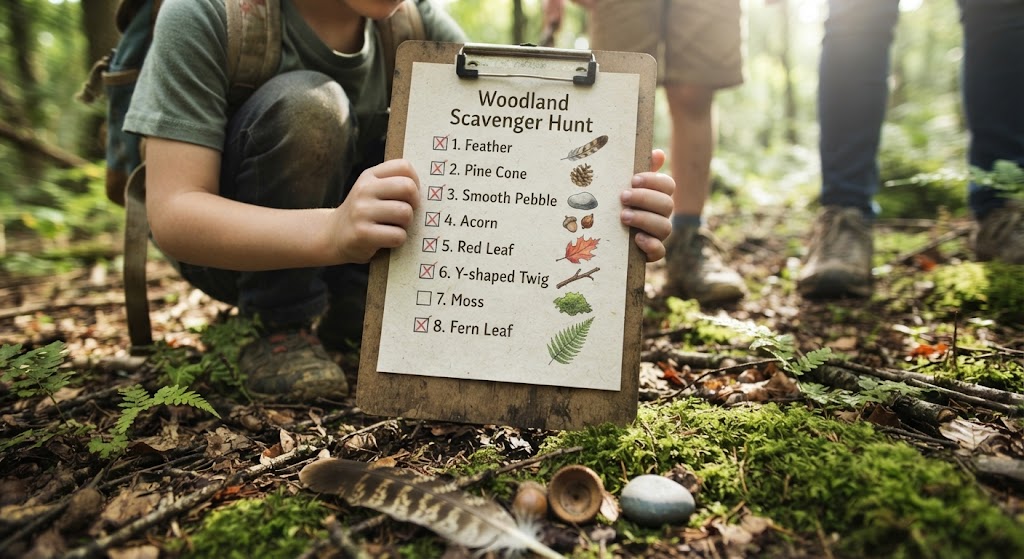
Give each team a list of things to identify.
Rather than simply asking them to find objects, make the challenges about purpose.
For example:
Find something that could help you stay dry.
Find something that would make you easier to see.
Find something that could help you carry another object.
Find something that could provide shade.
Find something that could help you communicate with another person.
The teams should write down their answers rather than removing anything from the environment.
Encourage them to explain why they selected each item.
If you’re running the activity indoors, use objects around the meeting place instead.
15–25 Minutes: Survival Scenarios
Bring the teams back together and give each one a fictional scenario.
For example:
Scenario A: You’re outside and the weather has suddenly become wet and windy.
Scenario B: Your group needs to attract attention from someone nearby.
Scenario C: You need to carry several items while keeping your hands free.
Scenario D: You need to create a comfortable place to wait while a leader deals with a problem.
Give each team a few minutes to identify resources in their surroundings that could help.
They should then explain their choices to the group.
There’s no need for one “correct” answer. Encourage Scouts to think about the advantages and disadvantages of their ideas.
Ask questions such as:
“Would it actually work?”
“Would it be safe?”
“Would there be a better option?”
“What might make your idea difficult?”
This encourages Scouts to think beyond simply spotting an object.
25–30 Minutes: What Would You Choose?
Finish with a quick group discussion.
Ask each Scout to choose the most useful thing they noticed during the activity and explain why.
Then ask what they would look for first if they were somewhere unfamiliar.
Bring the discussion back to the importance of observation.
A useful survival skill isn’t necessarily knowing exactly what to do immediately. It’s being able to stop, look around, assess the situation and make a sensible decision.
Safety
Scouts should remain within the boundaries established by the leader.
The activity should be based on observation rather than collecting natural materials.
Do not allow Scouts to taste or eat anything they find.
Unknown plants, fungi, berries, insects and other natural materials should not be handled unnecessarily.
Avoid areas with steep slopes, deep water, unstable ground, traffic or other hazards.
If the activity takes place outdoors, check the area beforehand and make sure Scouts understand where they are allowed to go.
Remind Scouts that an object being found in the environment does not automatically make it safe or suitable for use.
Leader Notes
The quality of this activity comes from the questions you ask afterwards.
If a Scout says they’ve found something that could be used as a shelter, don’t simply mark it correct. Ask them how they would use it, whether it would actually provide protection and whether there are any problems with their idea.
This encourages practical thinking rather than encouraging Scouts to believe that every natural object has an obvious survival use.
For Beavers, keep the challenges simple and focus on observation.
For Cubs, introduce more problem-solving and ask them to explain their choices.
For Scouts, make the scenarios more challenging and encourage them to consider several possible solutions before choosing one.
You can also run the activity using photographs if you don’t have access to an outdoor area.
Learning Outcomes
By the end of the activity, Scouts should have had the opportunity to develop:
Final Thought for Leaders
Scouts don’t always need to be given a piece of equipment and told how to use it.
Sometimes a more valuable lesson is simply learning to look carefully before making a decision.
The Survival Scavenger Hunt encourages Scouts to notice things they might normally walk straight past and think about how their surroundings could affect a situation.
Just as importantly, it teaches them that spotting a possible solution isn’t enough. They also need to ask whether that solution is safe, practical and appropriate.
🔒Ready to test your survival skills?
Join Survival Guides UK for free, complete challenges, earn badges and increase your Survival Level.
JOIN FREE →
CRAIG BURR
FOUNDER · SURVIVAL GUIDES UK
I'm Craig, the person behind Survival Guides UK. I created SGUK because I wanted somewhere people could learn real outdoor skills in a practical, straightforward way — from lighting a fire and tying knots to navigation, campcraft and everything in between.
You can read more about the story behind SGUK here as well as our approach here.