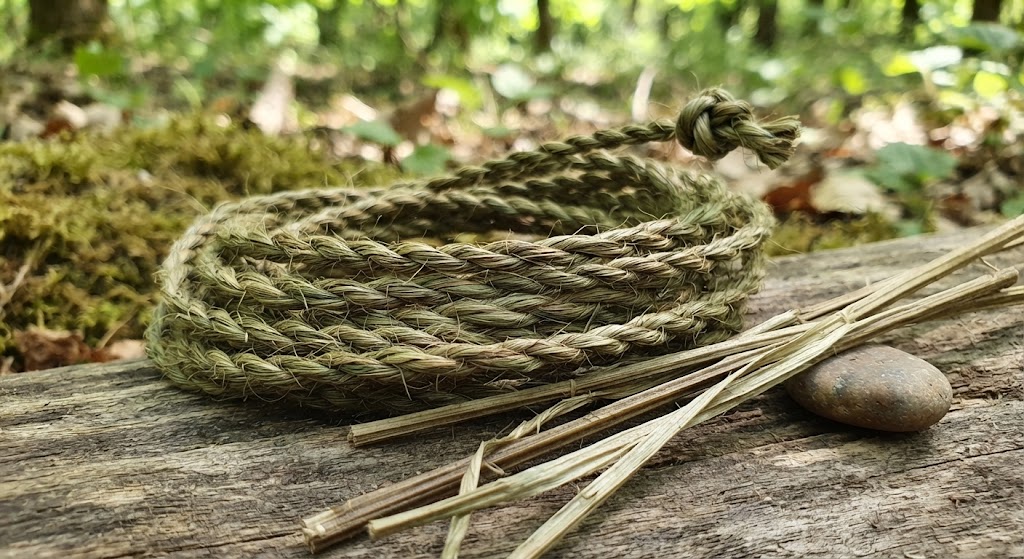
SGUK Outdoor Skills Challenge 23: Make Natural Cordage
Before modern rope was available, people used natural fibres to make natural cordage for tying, carrying and securing things. In this challenge, you’ll explore how fibres can be twisted together to make a simple piece of cordage and discover which materials work best.
The aim is to experiment, observe the results and learn something about a practical outdoor skill. You don’t need to produce perfect rope; you’re looking for a material that holds together when gently pulled.
Your Challenge
Make a short piece of natural cordage using a suitable natural fibre or a prepared plant-based material. Test it gently and record what you discover about its strength, flexibility and ease of use.
What You’ll Need
- Suitable natural fibres, such as dried grass or prepared plant fibres.
- A flat surface to work on.
- Scissors, if needed to prepare permitted materials.
- A notebook or phone to record your observations.
- A camera or phone to photograph your finished cordage.
Use materials from your garden or from a source where you have permission to collect them. Do not strip bark or remove plants from the wild without checking that collection is permitted.
Take the Challenge
Step 1: Choose your fibres
Select a small amount of suitable fibre. Dried grass can be useful for a simple experiment, while prepared natural fibres may be easier to work with if you’re a beginner. Avoid unknown plants and any material that could irritate your skin.
Step 2: Twist the fibres together
Separate the fibres into two small bundles. Twist each bundle in the same direction, then twist the two bundles around one another in the opposite direction. Keep the tension fairly even as you work, adding more fibre when necessary.
This two-part twisting method helps the strands hold together. Work slowly at first and don’t worry if your first attempt comes apart.
Step 3: Make and inspect your cordage
Continue until you have made a short length of cord. Look at how evenly the fibres sit together and whether the cord stays intact when you handle it.
Gently pull the ends to see whether the strands hold. Do not attach it to anything heavy or use it to support a person, equipment or a load that could cause injury if it breaks.
Step 4: Compare your results
If you have another suitable fibre available, make a second piece and compare the two. Which was easier to twist? Which held together better? Did one become brittle or start to unravel?
Record your observations. The experiment is about learning how the material behaves, not about making the strongest possible rope.
Check Your Results
Before completing the challenge, check that you can:
- Explain what natural cordage is.
- Twist fibres together to make a short cord.
- Describe how the cord behaves when gently pulled.
- Identify one thing you would change in your next attempt.
Complete the Challenge
Take a clear photograph of your finished natural cordage. If you’ve compared two materials, photograph both and explain briefly what you discovered.
How to Submit Your Challenge
- Go to your SGUK member profile.
- Open the Social Activity area.
- Upload a photograph of your natural cordage to your activity wall.
- Add the hashtag #SGUKChallenge23.
- Share your post for evidence verification.
Once you’ve shared your evidence and it has been verified, the SGUK Outdoor Skills Challenge 23 is complete and the completed challenges figure will be updated on your profile.
Challenge 23 Checklist
Want to Push Yourself?
Try making a second piece with a different suitable fibre. Compare the thickness, flexibility and strength of each piece, then decide which material you would choose for a simple outdoor binding task.
What’s Next?
For another practical outdoor skill, revisit SGUK Outdoor Skills Challenge 05: Make a Camp Gadget and think about where cordage could be useful when making simple camp equipment. You can also explore the other SGUK Outdoor Skills Challenges and choose a skill you’d like to practise next.
Each challenge can be completed in any order, so keep experimenting and building your practical outdoor knowledge.
Learn. Practise. Master.
That’s what the SGUK Outdoor Skills Challenge is all about.
🔒Ready to test your survival skills?
Join Survival Guides UK for free, complete challenges, earn badges and increase your Survival Level.
JOIN FREE →
CRAIG BURR
FOUNDER · SURVIVAL GUIDES UK
I'm Craig, the person behind Survival Guides UK. I created SGUK because I wanted somewhere people could learn real outdoor skills in a practical, straightforward way — from lighting a fire and tying knots to navigation, campcraft and everything in between.
You can read more about the story behind SGUK here as well as our approach here.