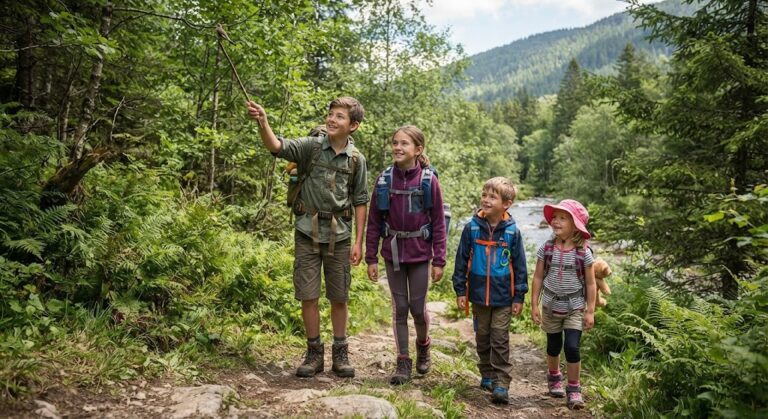
Family Outdoor Challenges: Fun Activities for Parents and Children
Family challenges are a great way to turn an ordinary afternoon into a small adventure.
You don’t need specialist equipment, expensive days out or a complicated plan. A local park, garden, woodland, beach or walking route can provide everything you need for a simple challenge that gets the whole family involved.
The best family challenges aren’t necessarily about winning.
They are about working together, trying something new, solving problems and spending time outdoors.
This guide brings together practical challenge ideas that families can adapt to suit different ages, abilities and locations.
What Makes a Good Family Challenge?
A good family challenge should be simple enough to understand but interesting enough to make people want to have a go.
It should also give everyone something useful to do.
For younger children, that might mean finding objects or completing a simple task.
Older children can take on planning, navigation and problem-solving.
Adults can join in rather than simply supervising from the sidelines.
The aim is to create something the whole family can experience together.
The One-Hour Outdoor Challenge
Set yourselves a one-hour mission.
You can choose the challenge yourselves, or combine several smaller tasks.
For example, your family might need to:
Find five different natural textures.
Build a small shelter.
Complete a short navigation route.
Identify three types of wildlife.
Take a photograph of an unusual natural feature.
Finish by everyone choosing their favourite discovery.
The exact challenges can be adapted to your surroundings.
Family Nature Hunt
Create a list of things to find outdoors.
You could look for:
Something smooth.
Something rough.
A feather.
A seed.
A yellow flower.
An interesting tree.
A bird.
An insect.
Something that makes a sound.
Something that has changed since your last visit.
Rather than collecting natural objects, take photographs or simply tick them off a list.
This keeps the challenge simple while avoiding unnecessary disturbance of plants and wildlife.
The Family Navigation Challenge
Navigation is an excellent family activity because different ages can participate at different levels.
Start with a simple route.
You might mark several points on a map and ask the family to work out the best order to visit them.
Younger children can help spot landmarks.
Older children can read the map.
Adults can allow children to make decisions while providing appropriate guidance.
For a more advanced challenge, introduce a compass and basic bearings if everyone is ready.
Make Your Own Treasure Trail
One family creates a trail for another family member to follow.
Use simple clues around a garden, park or other suitable area.
For example:
“Find somewhere you would sit on a sunny day.”
The next clue could be hidden nearby.
Older children can design increasingly complicated trails.
Younger children can use pictures or simple clues.
Before starting, check that the trail doesn’t lead anyone near unsafe areas.
Build a Family Shelter
Choose a safe outdoor location and give the family a simple construction challenge.
The goal could be:
“Build a shelter big enough for one person to sit inside.”
Use appropriate materials such as tarps, cardboard, blankets, sticks or other safe items.
Talk about what makes a shelter stable.
Where would rain run?
How could you make the entrance?
What would happen in strong wind?
The challenge becomes much more interesting when the family has to test and improve the design.
The Waterproof Shelter Challenge
Take the shelter idea one step further.
Build a small shelter for a toy or other suitable object.
Then test whether it can withstand a small amount of water.
Give the family time to redesign it if water gets through.
This introduces a useful cycle:
Build → Test → Improve.
It’s a simple way to teach problem-solving without making the activity feel like a classroom exercise.
Family Knot Challenge
If you have suitable rope or cord, choose one or two simple knots for everyone to learn.
Start with a demonstration.
Then practise together.
Once everyone has had a go, introduce a challenge.
Can you tie two pieces of cord together?
Can you make a loop?
Can you secure a bundle of sticks?
Can one family member explain the knot to another?
Keep the activity focused on simple practical skills.
Ordinary cord or rope should never be assumed to be suitable for supporting people or climbing.
Family Fireless Camp Challenge
You can recreate some of the organisation of camping without lighting a fire.
Give the family a challenge to design a miniature campsite.
Decide:
Where would the shelter go?
Where would you store equipment?
Where would you prepare food?
Where would you sit?
How would you keep wet equipment separate?
Where would you go if the weather became bad?
Younger children can draw the campsite.
Older children can create a physical model.
The Pack Your Own Adventure Challenge
Give each family member a scenario.
For example:
“You’re going on a three-hour walk and the weather might change.”
Everyone has to decide what they would take.
Lay the items out and compare the choices.
Ask:
“Why did you choose that?”
“What would you actually use?”
“What did you forget?”
This is particularly useful for older children because it encourages them to think about preparation rather than simply following an adult’s instructions.
Family Weather Challenge
Choose a day when the weather is changing.
Before going outside, everyone predicts what they think will happen.
Will it rain?
Will the wind increase?
Will the clouds clear?
Then go outside and observe.
Later, compare the predictions with what actually happened.
You can make it more challenging by asking older children to keep a simple weather record.
The Five-Minute Observation Challenge
Find a safe place to sit outdoors.
For five minutes, nobody talks.
Everyone simply watches and listens.
Afterwards, compare what each person noticed.
One person may have spotted a bird.
Another may have noticed insects.
Someone else may have noticed how the wind was moving through the trees.
This is an easy challenge but often surprisingly effective at getting children to slow down and pay attention.
Family Photo Challenge
Give everyone a list of photographs to take.
For example:
Something tiny.
Something huge.
An unusual texture.
A reflection.
A natural pattern.
Something moving.
Something that looks like a face.
The best part is comparing everyone’s interpretation afterwards.
Older children can be encouraged to think about composition and perspective.
The Colour Hunt
Choose several colours and see how many examples the family can find outdoors.
Try:
Red.
Yellow.
Green.
Brown.
Blue.
White.
Instead of picking flowers or disturbing plants, photograph the colours you find.
This works particularly well with younger children.
Family Scavenger Hunt
Create a scavenger hunt with a mixture of simple and challenging tasks.
Instead of just finding objects, include actions.
For example:
Find something shaped like a circle.
Find three different leaf shapes.
Hear two different birds.
Find somewhere sheltered from the wind.
Find evidence that an animal has been nearby.
Find something older than you.
This makes the activity about observation rather than collecting.
The Family Team Challenge
Split the family into pairs or small teams.
Give everyone the same practical problem.
For example:
“Build the tallest stable structure you can using these materials.”
Give each team a limited amount of time.
Then compare the designs.
The winning team doesn’t necessarily need to be the tallest.
You could judge the results based on stability, creativity, teamwork or the explanation of how the design works.
Build a Natural Obstacle Course
Create a simple course using safe features of your garden or suitable outdoor space.
Children might walk around markers, step over low objects, crawl beneath something suitable or balance along a safe surface.
The course should be appropriate for the children taking part.
Avoid creating obstacles that introduce unnecessary falls or collisions.
Older children can design the course themselves and explain how each section works.
Family Mini Expedition
Turn a normal walk into an expedition.
Before leaving, decide:
Where you’re going.
How long you expect to be out.
What you’ll take.
What the weather is doing.
What you want to discover.
During the walk, allow children to help with navigation and route decisions where appropriate.
The objective isn’t to cover a huge distance.
It’s to give the walk a purpose.
The “Find Your Way Home” Challenge
On a familiar route, allow older children to take more responsibility for navigation.
They can identify landmarks and decide which direction to take at suitable points.
Parents should remain appropriately involved, particularly where roads, water or other hazards are present.
The challenge is about learning navigation rather than deliberately becoming lost.
Family Problem-Solving Challenge
Give the family a fictional outdoor scenario.
For example:
“You’ve planned a picnic, but it starts raining.”
Ask everyone to suggest solutions.
Move somewhere sheltered?
Change the activity?
Continue with waterproofs?
Go home?
The family then discusses which option makes the most sense.
This encourages children to think about changing conditions and decision-making.
The No-Equipment Challenge
Give yourselves a challenge with one rule:
You can’t buy anything.
Use only what you already have or what is naturally available in the environment without damaging it.
Build something.
Create a game.
Make a route.
Design a treasure hunt.
Identify wildlife.
This can reveal just how little equipment is actually needed for an outdoor adventure.
Family Skills Challenge
Create a list of outdoor skills and work through them over several weeks.
You might include:
Learning a knot.
Reading a map.
Using a compass.
Packing a day bag.
Setting up a tent.
Identifying weather changes.
Planning a route.
Cooking outdoors where appropriate.
Building a shelter.
The family can keep track of which skills everyone has tried.
Turn Challenges Into Friendly Competition
Competition can make some activities exciting, but it doesn’t work for every child.
If you do use points, consider rewarding things other than simply finishing first.
You could award points for:
Good teamwork.
Creative ideas.
Helping someone else.
Good observation.
Safe decision-making.
Trying something difficult.
This keeps the emphasis on learning and cooperation.
Make Challenges Work for Different Ages
A family challenge doesn’t need to be identical for everyone.
A younger child might be asked to find three different leaves.
An older child could identify them.
A teenager might create a route using the discoveries as checkpoints.
An adult can help coordinate the activity.
Everyone is doing the same challenge at different levels.
This is often much more enjoyable than expecting every family member to perform exactly the same task.
Don’t Forget Accessibility
Outdoor challenges should be adapted so everyone can participate as fully as possible.
Think about the surface, distance, weather, equipment and physical demands.
A navigation challenge doesn’t have to involve a long hike.
A nature challenge can take place in a garden.
A shelter-building challenge can be completed at a table.
The objective is participation, not making the activity unnecessarily difficult.
Safety
Choose activities that are suitable for the ages, abilities and experience of everyone taking part.
Check the location before starting and consider hazards such as roads, water, steep ground, unstable surfaces, sharp objects, wildlife and changing weather.
Children should have appropriate supervision for the activity and environment.
Do not allow children to use fires, stoves, sharp tools or other potentially hazardous equipment without suitable adult supervision and instruction.
Don’t encourage children to climb trees, enter water or cross hazardous terrain simply to make a challenge more exciting.
Keep family challenges focused on sensible adventure and problem-solving rather than unnecessary danger.
If weather or environmental conditions become unsuitable, change the activity or head home.
Keeping Score
You can keep a simple scorecard if your family enjoys competition.
For example:
Challenge completed: 1 point
Creative solution: 1 point
Good teamwork: 1 point
Helpful behaviour: 1 point
Excellent observation: 1 point
You can also remove scoring completely.
For many families, the most enjoyable part is seeing what everyone comes up with.
Create a Family Challenge Jar
Write different activities on small pieces of paper and put them in a jar.
When the family wants something to do, choose one at random.
Ideas might include:
Nature hunt.
Treasure trail.
Navigation walk.
Shelter challenge.
Weather observation.
Photography challenge.
Outdoor games.
Mini expedition.
Knot challenge.
Map-making challenge.
This gives you a ready-made source of ideas without having to plan something from scratch every weekend.
Keep a Record of Your Adventures
A simple family adventure journal can make the challenges more meaningful.
Record:
Where you went.
What you did.
What worked.
What didn’t work.
Something funny that happened.
Something new you learned.
You could also add photographs or drawings.
Over time, this becomes a record of your family’s outdoor experiences.
Final Thought for Parents
Family challenges don’t have to be spectacular.
A ten-minute nature hunt in the garden can be just as valuable as a full-day adventure.
What matters is giving children a reason to explore, think, cooperate and try something new.
Let them make suggestions.
Let them solve problems.
Let them occasionally get things wrong and try again.
And don’t worry if the activity doesn’t go exactly according to plan.
Sometimes the unexpected moments become the best part of the adventure.
FAQ:
What are good outdoor challenges for families?
Nature hunts, treasure trails, navigation challenges, shelter building, photography challenges and weather observations are all simple activities that can be adapted for different ages.
Do family outdoor challenges need expensive equipment?
No. Many challenges can be completed using everyday household items or things already available outdoors, such as notebooks, cardboard, string and natural surroundings.
How can I make outdoor challenges suitable for different ages?
Give younger children simpler tasks while allowing older children to take on additional planning, navigation or problem-solving responsibilities.
Are outdoor challenges suitable for younger children?
Yes, provided the activity and environment are appropriate and children receive suitable supervision. Simple observation hunts and garden challenges can work particularly well for younger children.
What if the weather changes during a family outdoor challenge?
Be prepared to adapt the activity. A challenge can be shortened, moved indoors or replaced with another activity if conditions become unsuitable.
🔒Ready to test your survival skills?
Join Survival Guides UK for free, complete challenges, earn badges and increase your Survival Level.
JOIN FREE →
CRAIG BURR
FOUNDER · SURVIVAL GUIDES UK
I'm Craig, the person behind Survival Guides UK. I created SGUK because I wanted somewhere people could learn real outdoor skills in a practical, straightforward way — from lighting a fire and tying knots to navigation, campcraft and everything in between.
You can read more about the story behind SGUK here as well as our approach here.